Showing posts with label west african tribal art. Show all posts

Tuesday, February 28, 2017

The Nkondi or Nkonde Nail Fetish

Kongo Oath-taking and Healing Figure
Fetishes were protective figures used by individuals, families, or whole communities to destroy or weaken evil spirits, prevent or cure illnesses, repel bad deeds, solemnize contracts or oath-taking, and decide arguments. A diviner or holy person would activate the statue, using magical substances. Fetishes gained power and were effective because people believed in them.

The nkondi are the most powerful of the nkisi. They were used to identify and hunt down unknown wrongdoers such as thieves, and people who were believed to cause sickness or death by occult means. They were also used to punish people who swore false oaths and villages which broke treaties.

To inspire the nkondi to action, it was both invoked and provoked. Invocations, in bloodthirsty language, encouraged it to punish the guilty party. It would also be provoked by having gunpowder exploded in front of it, and having nails hammered into it. They were also used to literally "hammer out agreements"...with clear implications as to what would happen to people who broke the agreements.

Magic is practiced throughout Black Africa, but there are distinctions to be made among those who participate in it. The witch doctor is seen as someone who undertakes on his own account a personal communication with evil powers - suspected of casting spells, he is feared and rejected as the most dangerous individual in the tribe. The accusation of sorcery is a serious one.

The diviner, or fetishist, operates in principle for the good of all. His help is sought in times of need, for he is seen as the mediator between members of the tribe and all the powers of darkness. For this reason he also acts as healer.

The various attempts to influence the fearsome powers of the supernatural through the mediation of statues or fetishes have acquired particular intensity in the regions round the mouth of the River Congo, home of the Kongo, Yombe and Vili tribes, and this is also the case in the east of Zaire, among the Songye.

Magical objects were for many years little known in Europe, as Christian missionaries working in Africa tracked them down and had them burnt. Certain statues which were brought back to Europe by religious men, allegedly for documentation, were kept in secret and could not be studied. They were much feared for they seemed, even to European eyes, to have real power, a belief almost universally accepted in 17th-century Europe. Olfert Dapper was the first to look dispassionately at these "fetish" objects and to dare to describe them.

Property of the Rosenberg Collection
Recent work has led to a better understanding. They are wooden carvings, either anthropomorphic or zoomorphic, which are covered with a variety of objects such as nails or metal blades. The cavities in their back or stomach contain "medicines" - grains, hair, teeth or fingernails - which are held together with various binding materials. Pieces of fabric, feathers or lumps of clay are sometimes present.

Finally, bits of mirror, shiny metal or shells are used to close the cavities or to mark the eyes. Very often the faces alone are carved in detail, while the rest of the body - destined to be hidden under these various additional features - is sculpted more summarily. The figure's genitals may even be missing, either because they have never been carved or because they have been removed by a zealous missionary.

These figures have only a remote ancestral connection and they are distinguished from reliquaries by the absence of skulls or large bones, although some may sometimes fit into either category.

Generally grouped as Nkisi, they were the result of the combined work of two men, the carver and the fetishist. The former created the shape, but without the latter (the Nganga) the figure had no meaning. It was the Nganga who filled it with magic substances and completed the rituals which gave it supernatural powers.

Article and images, courtesy of Rand African Art 

Nkonde Nail Fetishes are often sold on eBay for around US$ 3,000 to US$ 5,000... 
What's In Your Attic?

https://siterubix.com/?a_aid=05a7f08a

Saturday, February 11, 2017

Head of a Queen Mother (Iyoba)

Head of a Queen Mother (Iyoba)
1750–1800 - Nigeria, Court of Benin
Courtesy: The MET Museum of Art
In the Benin kingdom, the iyoba, or mother of the oba (king), occupies an important and historically significant place within Benin's political hierarchy. The title was first conferred upon Idia, the mother of king Esigie, who used her political skill and supernatural abilities to save her son's kingdom from dissolution in the late fifteenth century. Ever since that time, queen mothers have been considered powerful protectors of their sons and, by extension, the kingdom itself. Because of the enormous esteem in which they are held, iyobas enjoy privileges second only to the oba himself, such as a separate palace, a retinue of female attendants, and the right to commission cast brass sculptures for religious or personal use.

Ancestral altars dedicated to past iyobas, like those of past kings, are furnished with cast brass commemorative heads. The heads of queen mothers are distinguished from those of kings by the forward-pointing peaks of their coral-beaded crowns. Commemorative heads of iyobas hold to the same stylistic chronology as those of obas. Earlier heads were cast with thinner walls and display tight beaded collars that fit snugly beneath the chin. Later versions have thicker walls, exhibit enlarged cylindrical collars that cover the face up to the lower lip, and are designed with a circular opening behind the peak of the crown to hold a carved ivory tusk. This head of an iyoba dates from the eighteenth century. While its high collar and pierced crown place it with later examples, the sensitive, naturalistic modeling of the face is reminiscent of the earliest commemorative heads.

Article: Courtesy of: The Metropolitan Museum of Art
Image: Courtesy of: The Metropolitan Museum of Art
Date: 1750–1800
Geography: Nigeria, Court of Benin
Culture: Edo peoples
Medium: Brass
Dimensions: H. 16 3/4 x Diam. 11 3/4 in. (42.5 x 29.9 cm)
Classification: Metal-Sculpture
Credit Line: Bequest of Alice K. Bache, 1977
Accession Number: 1977.187.36

Benin bronze heads are easily sold for $12,000 upwards on eBay... What's In Your Attic?


Tuesday, January 31, 2017

Kalimba, or the "Thumb Piano"

Nyonganyonga. Zambezi province,
Mozambique, ca. 1900.
Wood, shell, metal, beads.
In conjunction with the exhibition Early American Guitars: The Instruments of C. F. Martin, on view through December 7, the Department of Musical Instruments is presenting a series of monthly concerts on Friday evenings in the Museum's Charles Engelhard Court. The next concert in this series will be held on May 16, featuring the guitarist, composer, and instrument designer Trevor Gordon Hall.

Hall plays a rather unusual combination of two instruments, one that he calls the "kalimbatar." This hybrid instrument merges an acoustic guitar with a specially designed version of the West African kalimba.

Kalimba is one name for a type of instrument known as a lamellophone, consisting of thin metal or split cane tongues mounted on a resonating board or box. Depressing the free ends of the tongues with the thumb produces a gentle ringing sound, which is sometimes augmented by jingling objects. An example of a similar instrument, possibly by the Barwe people—members of the Shona community in the Zambezi province of Mozambique—can be found in the Museum's collection.

This example has thirty-one metal keys and disks made of snail shells that are pinned to the body and rattle when played. Tuning is accomplished by sliding the tongues in or out to alter their vibrating length and pitch.

Seated Chief Playing Thumb Piano
(Mwanangana). Angola, before 1869
Lamellophones are found across sub-Saharan Africa and were brought to Latin America by enslaved Africans. They are known by many names that may be shared with xylophones, but, overlooking differences in construction, are generally identified by two regional terms: mbira or sanza. Depending upon the context and regional tradition, lamellaphones may be used to accompany narratives and children's songs, or to summon spirits and induce trance and spirit possession, thus bridging this world with that of watchful ancestors.

The use of thumbs to play the instrument is the reason why the lamellophone is often known to Westerners as the "thumb piano."

- Article courtesy of The METMETmuseum.org
- Nyonganyonga. Zambesi province, Mozambique, ca. 1900. Wood, shell, metal, beads. Courtesy of The Metropolitan Museum of Art, New York, The Crosby Brown Collection of Musical Instruments, 1889 (09.163.6)
- Seated Chief Playing Thumb Piano (Mwanangana). Angola, before 1869. Wood (Uapaca), cloth, fiber, beads. Courtesy of The Metropolitan Museum of Art, New York, Rogers Fund, 1988 (1988.157)

Lamellophones, or "Thumb Pianos", are regularly sold for $200 to $300 on eBay... What's In Your Attic?


Thursday, January 26, 2017

The Dogon of Mali Way Of Life

A Dogon Mask
Courtesy of: http://www.hamillgallery.com
Dogon statues are conserved in the semi darkness of sanctuaries or of family homes. These objects are made to be touched rather than seen. Occasionally offerings and sacrifices are made to them. The statues are made by a blacksmith, who, if he has talent can create true works of art. The masks are sculpted by non specialists during the course of a ritual that takes place outside of the village.

Dogon style has evolved towards a type of cubism with ovoid heads, square shoulders, slender limbs, pointed breasts, forearm and thighs in the same parallel plane, and a coiffure stylized by two or three incisions. Dogon statues express in particular religious values and feelings. They act as a support to initiation rituals and in explaining the world.

The Dogon live in the south of Mali, a region which is made up of plains, a plateau and above all an escarpment. The Bandiagara escarpment is 260 km long and overhangs the plains. The Dogon cultivate millet, sorgho, fonio, rice and durum wheat at the edge of the cliffs and near the rare water points. They are not the first inhabitants of this region. The Dogon say that they came from Mande, or the Ancient Mali Empire to escape from Islamization. They probably started their migration between the 10th and 13th centuries and chased the Tellum from the cliffs. The memory of the Tellum is conserved in grain stores at the foot of the cliffs and rocky cavities where their dead were buried along with the statues.

Dogon Religion

Before the world was created, there was a God called Amma who had the appearance of an egg. Amma created four male and four female creatures. The males are: Nommo Die, Nommo Titiyayne, O Nommo and Ogo and were created in the form of fish. But Ogo rebelled before he was fully finished, as he wanted to make the creation his own. O Nommo was sacrificed to pay back the error of his twin Ogo and came down to earth in the ark that carried men’s ancestors and all living beings. Ogo, rebelling against Amma, detached himself from Amma’s placenta, ripping part of it away, and came down to earth with the ark.

In leaving Amma’s womb prematurely, he did not wait for the full gestation of his twin. He found himself weak and alone because Amma had transformed the piece of placenta torn out by Ogo, into our earth and the moon. Ogo, displeased with the earth, unfit for cultivation, went back up to the sky to interrupt Amma’s work and to retrieve the remains of his placenta. But Amma, wanting to put this piece of placenta out of Ogo’s reach, transformed it into our sun. Next, Amma transformed Ogo into a four legged creature, a pale fox that from that moment on would be the instrument of chaos in the universe. In accepting the opposition of the fox, and the chaos that he brought to the universe, Amma allowed psychological dualism and individualization to be created. In order to reorganize the universe that had been disturbed by the fox, Amma decided to sacrifice her twin brother O Nommo. His blood served to purify the earth and his body, cut into pieces, allowed the stars, the animals and the plants to appear. After this purification of the universe, O Nommo was brought back to life and sent back to earth by Amma, to give birth to humans and to reorganize life on earth. Amma had made men immortal, but following the chaos brought by the fox to the earth, death appeared. The ark in which Ogo had come down to earth became uncultivated land, and that of O Nommo the symbol for cultivated land. After all the beings had descended from the ark, O Nommo (or Nommo) returned to  his fish like form and went to live in the great expanse of water (the oceans) that had been born of the first rainfall. It is in the water that Nommo reveals to man the words woven through his teeth.

The Dogon religion is made up of the belief in Amma, distant and immaterial God, but which is realized through institutions and ongoing actions towards the ancestors:

1° The cult of the immortal totemic ancestors.

2° The Lebe cult, a great ancestor who died and was brought back to life in the form of a snake. Lebe is the great ancestor whose sons gave birth to the four tribes: Dyon, Dommo, Ono and Arou.

3° The mask cult, mortal ancestors.

The Dogon Economy

The Dogon are farming people, with a system of patrilineal descent and patrilocal residency. There is a division of labour. The men cultivate the fields and hunt albeit for a meager result (because of the lack of game) weave and make basket work. The women take care of the home, make pottery, spin cotton and dye fabric. The blacksmith doesn’t only work metal he also makes objects out of wood. He is an important person and belongs to a caste.

Social Organisation among the Dogon and Initiation rites

Comprising several totemic clans, the Dogon village comes under the authority of the council of elders. The clans are subdivided into lineages, led by the patriarch, the guardian of the ancestral altar and responsible for the cult.

There are other broader communities than the clan, these are the four initial tribes (Dyon, Arou, Ono, Dommo) each the respective descendant of the four mythical ancestors (Amma Serou, Libe Serou, Binou Serou, Dyongou Serou). In the beginning, they should have shared the Dogon country between them, but they were finally integrated into the same territory. It is at the heart of these tribal proceedings that the ‘Hogons’, or highest religious dignitaries and heads of a region, are named. They are in charge of the cult of the mythical snake Lebe and the cult of the ancestor Lebe Serou. Aided by the blacksmith, they preside over agrarian ceremonies. Masters of exchange and commerce they do not work the land and cannot leave their house, considered as a sanctuary. The supreme Hogon is the one that resides at Arou.

In correlation to this hierarchical relationship there is also a system of grouping by age, whereby the members mutually owe each other lifelong help and assistance.

Circumcision and excision open the door to adulthood and allows young people to marry and participate in social and ritualistic life.

Masculine and feminine associations are responsible for the initiation which is carried out by age group. Members of each age group owe mutual and lifelong help to the other members of the group. A boy’s initiation begins after his circumcision. This begins with teachings of traditional myths, taught through the medium of drawings and paintings. The boys learn man’s place in nature, society and the universe. Dogon mythology is so complicated that a griot would need a week to tell it in its entirety.

Blacksmiths and wood carvers form a separate caste. Their trade is mainly passed down from generation to generation. They are feared and respected by the community who attribute particular powers to them. They can only marry inside their own caste. The women take care of the pottery.

Great Dogon Ceremonies

The masculine association or ‘Awa’ is responsible for initiation and equally organizes the great ceremonies that take place at the end of the mourning period. This period can last for several days and recalls the memories of people that have died within the last two or three years. Two main types of mask are made for these occasions:

The ‘Sirige,’ or house with several storeys, is worn by a dancer who mimics the myth of creation and the descent from the ark. The Kanaga mask is crowned by a cross indicating the skies and the earth. They are accompanied by other types of zoomorphic masks: antelope, hyena, lion, hare, monkey, buffalo, bird, as well as other helm masks embellished with horns and a muzzle. These masks might be decorated in red, black or white.

The grand Sigui ceremony takes place every 60 years. It is symbolized by a snake mask, and everyone in the community takes part in the event.

Dogon Sculpture

Dogon sculpture is conserved in the semi darkness of sanctuaries or of family homes. These objects are
made to be touched rather than seen. Occasionally, offerings and sacrifices are made to them.

The masks are sculpted by non specialists during the course of a ritual that takes place outside of the village. The statues are made by a blacksmith who, if he has talent, can create true works of art in his house situated in a quarter reserved especially for professionals who work under the watchful eye of the population. The quality of the work also depends on the wealth of the person who commissions it.

In this region of Mali, it is important to recognize the works of art that were made by the Tellum, the predecessors of the Dogon, who occupied the area in the 11th and 12th centuries.

The main theme of the statues is the sacrifice of Nommo. The statues are created from a wood that is thought to be hard and powerful.  They follow the relationship of Nommo and Amma at various periods of their lives.

The signification of the different representations is mainly as follows:

If the statue has one arm raised up it symbolizes the relationship between O Nommo and Amma before his sacrifice, but also of his role as the organizer of the world. Sometimes, he is hermaphrodite because Nommo is bisexual. When both arms are raised but separated, Nommo is praying to Amma to allow him to stay with her after his resurrection. If both arms are raised and joined together, Nommo is praying for Amma to come to him and protect him. When both arms are raised with the hands together and the palms facing up to the sky, Nommo is imploring the rain to fall. When both arms are down by the sides this position symbolizes Nommo’s descent to earth. With both arms spread out away from the body and with the palms facing forward, Nommo reveals his role of guardian of space. If Nommo has both hands placed on his thighs this means that he is relying on Amma.

Throughout these different representations, the face is often very smooth signifying that the world must remain clean and organized like a smoothly shaved face.
A couple of primordial ancestors.
Courtesy of http://www.hamillgallery.com

The figure of a man’s statue incorporates traits that are the essence of Dogon sculpture. They translate the monumentality that is obtained through a strict use of volume, reducing the physiognomy down to the essential (without superfluous detail), disturbing the serious face of the character with its long and extremely triangular nose.

A couple of primordial ancestors, sitting side by side share the same characteristics. The faces are harsh and the rigidity of the pair is only broken by the gesture of tenderness of the man putting his arm around his companion’s shoulder.

Again, the same characteristics apply for a statue of a woman sitting on a stool decorated with sculptures of the ancestors. The coiffure of the seated woman is more heavily refined, but the principal traits of the face are schematic: diamond shaped eyes, rectilinear nose in the form of an arrow, slit mouth. Sculptures of women with children are treated in the same austere and monumental manner. A woman crushing seeds is sculpted in the same synthetic manner, without any anecdotal features.

Xylophone or balafon players are treated in the same hieratic way, full of nobility and severity.

A great number of figures recall that Nommo pulled the ark towards a hollow filled with water by changing himself into a horse.

  • The Dogon create hermaphrodite, ‘Tellum type’ statues where the arms are raised and which are covered with a thick patina of blood and millet beer.
  • The four Nommo couples, mythical ancestors born of the God Amma, decorate stools, the columns of the men’s meeting houses, as well as locks and barn doors.
  • The primordial couple is represented sitting on a stool, of which the base represents the earth and the top tray the sky. Between the base and the tray Nommo is figured, the ancestor of all humans.
  • The feminine seated figures, with their hands on their stomachs, are linked to the fecundity cult and are the incarnation of the first dead ancestor that died in childbirth. They are the object of offerings and sacrifices made by pregnant women.
  • The kneeling statues of the protecting ancestors are placed next to the deceased’s head in order to absorb his spiritual force. They play an intermediary role with the afterlife by accompanying the deceased. They are then returned to the ancestral altars.

Dogon style has evolved towards a type of cubism with ovoid heads, square shoulders, slender limbs, pointed breasts, forearm and thighs in the same parallel plane, a coiffure stylized by two or three incisions. Dogon statues express in particular religious values and feelings. They act as a support to initiation and as an explanation of the world itself. Hidden in sanctuaries or in the Hogan’s dwelling, they act as vectors of knowledge for the initiate who will learn how to interpret the signs of the statue depending on his level of knowledge.

Dogon art also manifests itself in architecture, and both cult and domestic objects.

Dogon blacksmiths also make ritual irons showing Nommo in various stances and situations as for the statues, but along with some fish like elements.

Article courtesy of African-Art.net
Images courtesy of HamillGallery.com  

Monday, January 23, 2017

History of the Marka Masks of Mali, West Africa

Courtesy of Fondazione Passaré
Marks Masks of Mali
The masks of the Marka (a Mande subgroup) originated in the landlocked country of Mali, West Africa. Long ago masks such as the Marka were thought to be extremely powerful and had the ability to frighten away evil spirits, convey messages from the spirit world and cure illnesses. The Marka would perform ceremonies devoted to fishing and farming, and their stylized masks would be danced to invoke the spirits to grant the community with abundant agricultural yields and a successful fishing season.

The masks of the Marka are narrow and austere, with a sharp chin. They are brightly painted or coated with metal along with raised ornamentation, achieving a fine decorative effect that is very distinctive and different from most other African mask styles. The men of the Marka, clad in costumes of colorful cloth, always appear in pairs to represent man's wooing of woman. The most characteristic deviation from the Bambara style is the cover of metal sheeting worked in conjunction with three metal bars attached to the forehead and red cotton at the end of each. The Marka society used this mask in two rituals, at the circumcision ceremony of adolescents, and when circumcised men advance from one grade to another. Along the Niger River the Marka used the masks in ceremonies related to fishing and farming.

This ethnic group is independent from the Bambara tribe but their styles show a strong Bambara influence. They live in the region that extends from the north of the Bambara to the Senegalese border. They live principally from agriculture with some subsidiary cattle rearing in the northern part of their territory. The dry savanna permits no more than a subsistence economy, and the soil produces, with some difficulty, millet, rice, and beans.

Courtesy of Fondazione Passaré
Marks Masks of Mali
Fertility played an important role in African Agricultural ceremonies. They were based on the idea that through the correct rituals, man could raise up the vital forces dwelling in a mask by gaining the blessing of his ancestor in order to help fertility and therefore achieve protection and primary security. The Agricultural Festivities the Africans celebrated were performed at different stages of the crop cycle. This crop cycle started with clearing of the land, then the planting, the reaping of the fruits, the harvest and finally the filling of the food stores. The concept of these festivals was the sacredness of the soil, which belonged to the ancestors, or the "masters of the soil". A successful harvest therefore depended on the thanksgiving of the ancestors or sometimes upon the good will of the goddess of the earth. African Masks

To see beautiful and affordable African Home Decor crafted by talented local African artisans, click on the following link: African Home Decor
Article Source: http://EzineArticles.com/expert/Mike_Griffis/268004

A Senufo sculpture was recently sold for $4,100 on eBay... 
What's In Your Attic?


Friday, September 11, 2015

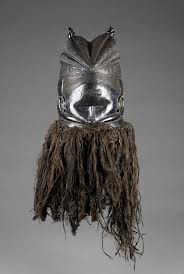
The Mende Helmet Mask "Bundu" or "Sowei" Mask of the Sande Society

In sub-Saharan Africa only men are normally permitted on ritual occasions to wear wooden masks. This black helmet mask is worn exclusively by women. The practice of women wearing masks seems to have been brought to several populations of  Sierra Leone and Liberia, such as the Temne, Gola and Vai, by the Mende and Mande-speaking people from the northern savanna. Because of the similarity of mask styles and the itinerant pathways of noted carvers, it is difficult to assign some masks to a particular ethnic group.

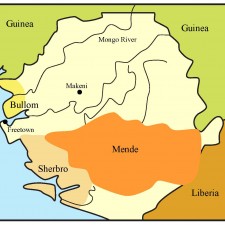
In the 19th century the Mende were organized into independent chiefdoms; families and individuals were ranked according to their land-use rights. Industrious rice farmers, the Mende number approximately two million people. The rituals of their women's society, called Sande, require the appearance of masked figures. Within such a large population there are many variations in local practices and carving styles, but there is broad agreement on the nature of the mask itself.

The mask presents an ideal of feminine beauty admired by the Mende: elaborate hairstyle, full forehead and small facial features.The gleaming surface signifies healthy, glowing skin. The swelling fleshy rolls alternating with deep incised lines at the neck or back of the head are considered marks of beauty and a promise of fecundity. The neck is broad to fit over the head of the woman who will wear it. Sande officials commission male carvers to produce the mask in secret. The surface is smoothed with the rough leaves of the ficus tree, then dyed black with a concoction made of leaves. Before use, it is anointed with palm oil to make it shine. (Modern carvers use black shoe polish.)

With this confining mask, the wearer (who has to be a good dancer and an official of the Sande) puts on a
thick cotton costume covered with heavy fibre strands dyed black. Her dances may last for over two hours. The sacredness of the mask lies in its deeper meaning as a representation of the long deceased founder of Sande society. In pre-colonial times women could hold the position of chief of a village cluster; until the 1970s women politicians continued to use the Sande society to support and further their careers in modern government. With increasingly rigorous Islamisation, however, the Sande society is being seriously modified or even disbanded.

"The costume worn with the black mask is made of layers of raffia fibers that have also been dyed black. These are attached to the lower portion of the neck as well as to a black cloth shirt or gown worn over the body. The sleeves are sewn shut, and long stockings or men's shoes are worn. No part of the body is left exposed, for revealing the body would expose the human agency behind the mask to the eyes of nonmembers, and would also allow the spirit to enter the human dancer rather than the mask.

Masked dancing provides a festive mood appropriate to the completion of the several stages of initiation. Masks are seen in public at several key moments during the process. Their appearances serve to announce to families of initiates that certain stages have been successfully accomplished and that preparation of foods and gifts of money must be completed. A mask may collect food from the community to take back to where initiation is taking place. She comes into the community to announce the imminent coming out of the girls, and she leads them into town on their first visit after the process has started. Finally, she leads the richly dressed girls into town when they have completed their training and are released. This is the high point of the entire process, for the girls are now recognized as marriageable, adult women.


The mask may appear at other times to bring justice to offenders of Sande law, to perform in respect at the funeral of an important leader of the society, and to participate in ceremonies in which a new mask is initiated into the work of Sande. Nowö is accepted as a living presence. The spirit speaks not through words but through the language of dance, referring to moral and social doctrines of beauty, serenity, dignity, control, order, and balance. Dance movements exaggerate the powers of ordinary women and dramatize the ideals of feminine beauty."

Excerpt above from: Poynor, Robin. 1995. African Art at the Harn Museum: Spirit Eyes, Human Hands. pp. 185-191. Article from the Rand African Art website - Denver, Colorado