 |
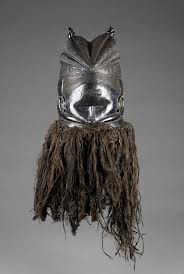
| A Dogon Mask Courtesy of: http://www.hamillgallery.com |
Dogon style has evolved towards a type of cubism with ovoid heads, square shoulders, slender limbs, pointed breasts, forearm and thighs in the same parallel plane, and a coiffure stylized by two or three incisions. Dogon statues express in particular religious values and feelings. They act as a support to initiation rituals and in explaining the world.
The Dogon live in the south of Mali, a region which is made up of plains, a plateau and above all an escarpment. The Bandiagara escarpment is 260 km long and overhangs the plains. The Dogon cultivate millet, sorgho, fonio, rice and durum wheat at the edge of the cliffs and near the rare water points. They are not the first inhabitants of this region. The Dogon say that they came from Mande, or the Ancient Mali Empire to escape from Islamization. They probably started their migration between the 10th and 13th centuries and chased the Tellum from the cliffs. The memory of the Tellum is conserved in grain stores at the foot of the cliffs and rocky cavities where their dead were buried along with the statues.
Dogon Religion
Before the world was created, there was a God called Amma who had the appearance of an egg. Amma created four male and four female creatures. The males are: Nommo Die, Nommo Titiyayne, O Nommo and Ogo and were created in the form of fish. But Ogo rebelled before he was fully finished, as he wanted to make the creation his own. O Nommo was sacrificed to pay back the error of his twin Ogo and came down to earth in the ark that carried men’s ancestors and all living beings. Ogo, rebelling against Amma, detached himself from Amma’s placenta, ripping part of it away, and came down to earth with the ark.
In leaving Amma’s womb prematurely, he did not wait for the full gestation of his twin. He found himself weak and alone because Amma had transformed the piece of placenta torn out by Ogo, into our earth and the moon. Ogo, displeased with the earth, unfit for cultivation, went back up to the sky to interrupt Amma’s work and to retrieve the remains of his placenta. But Amma, wanting to put this piece of placenta out of Ogo’s reach, transformed it into our sun. Next, Amma transformed Ogo into a four legged creature, a pale fox that from that moment on would be the instrument of chaos in the universe. In accepting the opposition of the fox, and the chaos that he brought to the universe, Amma allowed psychological dualism and individualization to be created. In order to reorganize the universe that had been disturbed by the fox, Amma decided to sacrifice her twin brother O Nommo. His blood served to purify the earth and his body, cut into pieces, allowed the stars, the animals and the plants to appear. After this purification of the universe, O Nommo was brought back to life and sent back to earth by Amma, to give birth to humans and to reorganize life on earth. Amma had made men immortal, but following the chaos brought by the fox to the earth, death appeared. The ark in which Ogo had come down to earth became uncultivated land, and that of O Nommo the symbol for cultivated land. After all the beings had descended from the ark, O Nommo (or Nommo) returned to his fish like form and went to live in the great expanse of water (the oceans) that had been born of the first rainfall. It is in the water that Nommo reveals to man the words woven through his teeth.
The Dogon religion is made up of the belief in Amma, distant and immaterial God, but which is realized through institutions and ongoing actions towards the ancestors:
1° The cult of the immortal totemic ancestors.
2° The Lebe cult, a great ancestor who died and was brought back to life in the form of a snake. Lebe is the great ancestor whose sons gave birth to the four tribes: Dyon, Dommo, Ono and Arou.
3° The mask cult, mortal ancestors.
The Dogon Economy
The Dogon are farming people, with a system of patrilineal descent and patrilocal residency. There is a division of labour. The men cultivate the fields and hunt albeit for a meager result (because of the lack of game) weave and make basket work. The women take care of the home, make pottery, spin cotton and dye fabric. The blacksmith doesn’t only work metal he also makes objects out of wood. He is an important person and belongs to a caste.
Social Organisation among the Dogon and Initiation rites
Comprising several totemic clans, the Dogon village comes under the authority of the council of elders. The clans are subdivided into lineages, led by the patriarch, the guardian of the ancestral altar and responsible for the cult.
There are other broader communities than the clan, these are the four initial tribes (Dyon, Arou, Ono, Dommo) each the respective descendant of the four mythical ancestors (Amma Serou, Libe Serou, Binou Serou, Dyongou Serou). In the beginning, they should have shared the Dogon country between them, but they were finally integrated into the same territory. It is at the heart of these tribal proceedings that the ‘Hogons’, or highest religious dignitaries and heads of a region, are named. They are in charge of the cult of the mythical snake Lebe and the cult of the ancestor Lebe Serou. Aided by the blacksmith, they preside over agrarian ceremonies. Masters of exchange and commerce they do not work the land and cannot leave their house, considered as a sanctuary. The supreme Hogon is the one that resides at Arou.
In correlation to this hierarchical relationship there is also a system of grouping by age, whereby the members mutually owe each other lifelong help and assistance.
Circumcision and excision open the door to adulthood and allows young people to marry and participate in social and ritualistic life.
Masculine and feminine associations are responsible for the initiation which is carried out by age group. Members of each age group owe mutual and lifelong help to the other members of the group. A boy’s initiation begins after his circumcision. This begins with teachings of traditional myths, taught through the medium of drawings and paintings. The boys learn man’s place in nature, society and the universe. Dogon mythology is so complicated that a griot would need a week to tell it in its entirety.
Blacksmiths and wood carvers form a separate caste. Their trade is mainly passed down from generation to generation. They are feared and respected by the community who attribute particular powers to them. They can only marry inside their own caste. The women take care of the pottery.
Great Dogon Ceremonies
The masculine association or ‘Awa’ is responsible for initiation and equally organizes the great ceremonies that take place at the end of the mourning period. This period can last for several days and recalls the memories of people that have died within the last two or three years. Two main types of mask are made for these occasions:
The ‘Sirige,’ or house with several storeys, is worn by a dancer who mimics the myth of creation and the descent from the ark. The Kanaga mask is crowned by a cross indicating the skies and the earth. They are accompanied by other types of zoomorphic masks: antelope, hyena, lion, hare, monkey, buffalo, bird, as well as other helm masks embellished with horns and a muzzle. These masks might be decorated in red, black or white.
The grand Sigui ceremony takes place every 60 years. It is symbolized by a snake mask, and everyone in the community takes part in the event.
Dogon Sculpture
Dogon sculpture is conserved in the semi darkness of sanctuaries or of family homes. These objects are
made to be touched rather than seen. Occasionally, offerings and sacrifices are made to them.
The masks are sculpted by non specialists during the course of a ritual that takes place outside of the village. The statues are made by a blacksmith who, if he has talent, can create true works of art in his house situated in a quarter reserved especially for professionals who work under the watchful eye of the population. The quality of the work also depends on the wealth of the person who commissions it.
In this region of Mali, it is important to recognize the works of art that were made by the Tellum, the predecessors of the Dogon, who occupied the area in the 11th and 12th centuries.
The main theme of the statues is the sacrifice of Nommo. The statues are created from a wood that is thought to be hard and powerful. They follow the relationship of Nommo and Amma at various periods of their lives.
The signification of the different representations is mainly as follows:
If the statue has one arm raised up it symbolizes the relationship between O Nommo and Amma before his sacrifice, but also of his role as the organizer of the world. Sometimes, he is hermaphrodite because Nommo is bisexual. When both arms are raised but separated, Nommo is praying to Amma to allow him to stay with her after his resurrection. If both arms are raised and joined together, Nommo is praying for Amma to come to him and protect him. When both arms are raised with the hands together and the palms facing up to the sky, Nommo is imploring the rain to fall. When both arms are down by the sides this position symbolizes Nommo’s descent to earth. With both arms spread out away from the body and with the palms facing forward, Nommo reveals his role of guardian of space. If Nommo has both hands placed on his thighs this means that he is relying on Amma.
Throughout these different representations, the face is often very smooth signifying that the world must remain clean and organized like a smoothly shaved face.
 |
| A couple of primordial ancestors. Courtesy of http://www.hamillgallery.com |
The figure of a man’s statue incorporates traits that are the essence of Dogon sculpture. They translate the monumentality that is obtained through a strict use of volume, reducing the physiognomy down to the essential (without superfluous detail), disturbing the serious face of the character with its long and extremely triangular nose.
A couple of primordial ancestors, sitting side by side share the same characteristics. The faces are harsh and the rigidity of the pair is only broken by the gesture of tenderness of the man putting his arm around his companion’s shoulder.
Again, the same characteristics apply for a statue of a woman sitting on a stool decorated with sculptures of the ancestors. The coiffure of the seated woman is more heavily refined, but the principal traits of the face are schematic: diamond shaped eyes, rectilinear nose in the form of an arrow, slit mouth. Sculptures of women with children are treated in the same austere and monumental manner. A woman crushing seeds is sculpted in the same synthetic manner, without any anecdotal features.
Xylophone or balafon players are treated in the same hieratic way, full of nobility and severity.
A great number of figures recall that Nommo pulled the ark towards a hollow filled with water by changing himself into a horse.
- The Dogon create hermaphrodite, ‘Tellum type’ statues where the arms are raised and which are covered with a thick patina of blood and millet beer.
- The four Nommo couples, mythical ancestors born of the God Amma, decorate stools, the columns of the men’s meeting houses, as well as locks and barn doors.
- The primordial couple is represented sitting on a stool, of which the base represents the earth and the top tray the sky. Between the base and the tray Nommo is figured, the ancestor of all humans.
- The feminine seated figures, with their hands on their stomachs, are linked to the fecundity cult and are the incarnation of the first dead ancestor that died in childbirth. They are the object of offerings and sacrifices made by pregnant women.
- The kneeling statues of the protecting ancestors are placed next to the deceased’s head in order to absorb his spiritual force. They play an intermediary role with the afterlife by accompanying the deceased. They are then returned to the ancestral altars.
Dogon style has evolved towards a type of cubism with ovoid heads, square shoulders, slender limbs, pointed breasts, forearm and thighs in the same parallel plane, a coiffure stylized by two or three incisions. Dogon statues express in particular religious values and feelings. They act as a support to initiation and as an explanation of the world itself. Hidden in sanctuaries or in the Hogan’s dwelling, they act as vectors of knowledge for the initiate who will learn how to interpret the signs of the statue depending on his level of knowledge.
Dogon art also manifests itself in architecture, and both cult and domestic objects.
Dogon blacksmiths also make ritual irons showing Nommo in various stances and situations as for the statues, but along with some fish like elements.
Article courtesy of African-Art.net
Images courtesy of HamillGallery.com




.jpg)

