Showing posts with label africa. Show all posts

Tuesday, February 28, 2017

The Nkondi or Nkonde Nail Fetish

Kongo Oath-taking and Healing Figure
Fetishes were protective figures used by individuals, families, or whole communities to destroy or weaken evil spirits, prevent or cure illnesses, repel bad deeds, solemnize contracts or oath-taking, and decide arguments. A diviner or holy person would activate the statue, using magical substances. Fetishes gained power and were effective because people believed in them.

The nkondi are the most powerful of the nkisi. They were used to identify and hunt down unknown wrongdoers such as thieves, and people who were believed to cause sickness or death by occult means. They were also used to punish people who swore false oaths and villages which broke treaties.

To inspire the nkondi to action, it was both invoked and provoked. Invocations, in bloodthirsty language, encouraged it to punish the guilty party. It would also be provoked by having gunpowder exploded in front of it, and having nails hammered into it. They were also used to literally "hammer out agreements"...with clear implications as to what would happen to people who broke the agreements.

Magic is practiced throughout Black Africa, but there are distinctions to be made among those who participate in it. The witch doctor is seen as someone who undertakes on his own account a personal communication with evil powers - suspected of casting spells, he is feared and rejected as the most dangerous individual in the tribe. The accusation of sorcery is a serious one.

The diviner, or fetishist, operates in principle for the good of all. His help is sought in times of need, for he is seen as the mediator between members of the tribe and all the powers of darkness. For this reason he also acts as healer.

The various attempts to influence the fearsome powers of the supernatural through the mediation of statues or fetishes have acquired particular intensity in the regions round the mouth of the River Congo, home of the Kongo, Yombe and Vili tribes, and this is also the case in the east of Zaire, among the Songye.

Magical objects were for many years little known in Europe, as Christian missionaries working in Africa tracked them down and had them burnt. Certain statues which were brought back to Europe by religious men, allegedly for documentation, were kept in secret and could not be studied. They were much feared for they seemed, even to European eyes, to have real power, a belief almost universally accepted in 17th-century Europe. Olfert Dapper was the first to look dispassionately at these "fetish" objects and to dare to describe them.

Property of the Rosenberg Collection
Recent work has led to a better understanding. They are wooden carvings, either anthropomorphic or zoomorphic, which are covered with a variety of objects such as nails or metal blades. The cavities in their back or stomach contain "medicines" - grains, hair, teeth or fingernails - which are held together with various binding materials. Pieces of fabric, feathers or lumps of clay are sometimes present.

Finally, bits of mirror, shiny metal or shells are used to close the cavities or to mark the eyes. Very often the faces alone are carved in detail, while the rest of the body - destined to be hidden under these various additional features - is sculpted more summarily. The figure's genitals may even be missing, either because they have never been carved or because they have been removed by a zealous missionary.

These figures have only a remote ancestral connection and they are distinguished from reliquaries by the absence of skulls or large bones, although some may sometimes fit into either category.

Generally grouped as Nkisi, they were the result of the combined work of two men, the carver and the fetishist. The former created the shape, but without the latter (the Nganga) the figure had no meaning. It was the Nganga who filled it with magic substances and completed the rituals which gave it supernatural powers.

Article and images, courtesy of Rand African Art 

Nkonde Nail Fetishes are often sold on eBay for around US$ 3,000 to US$ 5,000... 
What's In Your Attic?

https://siterubix.com/?a_aid=05a7f08a

Monday, February 13, 2017

The African Maternity Figures

Afo peoples, Nigeria, 19th century
(wood)
Since the 1940s, the excavations in the inland delta region of the Niger River near Djenne in Mali have yielded numerous sculptured terra-cotta, cast copper-alloy, and gold figures representing humans and animals. These sculptures originated in advanced, flourishing cultures that may have existed as early as the eighth century A.D. or as late as the seventeenth century.

Figures representing a mother and child seem to occur less frequently than other subjects, such as chiefs or warriors on horseback, reclining or kneeling females, or animals, especially snakes. The meaning of these ancient maternity figures is unknown. Perhaps such figures served as symbols of the primordial mother or another mythical figure in the history of a clan in which the sculpture originated. Regrettably, the stratigraphic context in which most of these objects have been discovered and other pertinent data are unknown. Even so, it is possible to date the objects.

The proliferation of decorative details on the figure includes serpents, which are depicted as zigzags. Snakes commonly occur in the visual arts as well as in the oral traditions of numerous peoples of the inland delta region. Snakes play an important role in the cosmology and mythical origins of the clan. For example, snakes are king makers, designating the successful candidate by touching him with the nose. Snakes are often considered to be symbols of immortality throughout sub-Saharan Africa because they "renew" themselves by shedding their skin.

Asante group, Akan peoples, Ghana
19th-20th century (wood)
Fertility and children are the most frequent themes in the wooden sculptures of the Asante. Thus the most numerous works are akua'ba fertility figures and mother-and-child figures. In traditional Asante society, in which inheritance was through the maternal line, a woman's essential role was to bear children, preferably girls to continue the matrilineage. Sculptured mother-and-child figures show the mother nursing or holding her breast, as exemplified by this figure. Such gestures express Asante ideas about nurturing, the family, and the continuity of a matrilineage through a daughter or of a state through a son.

This figure does not depict an ordinary mother. Rather, as indicated by her elevated sandaled feet, the figure represents a queen mother as she would sit in state on formal occasions. Such royal maternity figures were kept with the venerated seats of ancestral chiefs in special rooms, or they were housed in the shrines of powerful deities that were particularly concerned with the well-being of a royal person, perhaps a queen mother.

According to Yoruba belief, children are blessings from the gods. Before the advent of modern medicine, women petitioned certain deities for fertility and the birth of a healthy infant. The shrines to these deities - Erinle, Yemoja, Shango, Ogun, and others - were adorned with sculptured figures representing a mother and child, as exemplified by this figure. The absence of cult attributes makes specific identification of this figure impossible. The kneeling position is a gesture of respect, devotion, and submission. Thus the figure represented in the carving is probably a petitioner rather than a deity. The sculpture may have been a votive offering from a woman who had successfully petitioned for a child, a priest or priestess of a cult, or even the entire body of
worshipers.

Afo maternity figures are thought to represent an ancestral mother and are owned by individual villages.These figures are brought out of their shrines once a year for the Aya ceremony. At this time, men pray for increased fertility in their wives and make gifts of food and money to the ancestor.

Extant maternity figures from the Afo are usually monoxylous, that is, carved from one piece, and are usually shown with only one child. It was customary in the grasslands Batufam Kingdom to have portrait statues carved of the new fon (king) and the wife who bore his first child. According to royal custom, the heir to the throne could not rule until he proved his fertility. The sculptures were executed within two years of the beginning of the reign and were used in the rites of installation of the successor.

Female figure with child
Kongo people, Congo
(wood)
The Kongo Kingdom flourished from c. 1300 to the mid-seventeenth century. The Kongo were the first people of Central Africa to make contact with the Portuguese navigators, who first arrived in 1482 and brought with them Catholic missionaries, merchants, and artisans. The Kongo aristocracy embraced Christianity and Western culture, and trade with Portugal resulted in increased wealth and military power. From the capital at Sao Salvador in present-day Angola, Kongo rule extended into portions of Zaire, Congo, Cabinda, and numerous small coastal and inland chiefdoms in Angola. Around the mid-seventeenth century, the once-powerful kingdom began to founder and shrink. Finally, it collapsed and became decentralized.

Among the symbols of rank belonging to Kongo kings and chiefs were scepters (mvuala) made of hardwood and usually topped by an ancestor figure carved of precious ivory. Very often the ancestor so represented was a female (Cornet 1971, 48). Because power was transmitted through the female line, rulers were selected from among the matrilineage. The king's mother was titled the "queen mother," and although she did not share rule with her son, she held a position of respect and privilege.

Article and images, courtesy of Rand African Art 

A Kongo-Yombe Maternity Figure has recently been sold for US$ 3,525,000 by Sotheby's... 
What's In Your Attic?


Monday, January 23, 2017

History of the Marka Masks of Mali, West Africa

Courtesy of Fondazione Passaré
Marks Masks of Mali
The masks of the Marka (a Mande subgroup) originated in the landlocked country of Mali, West Africa. Long ago masks such as the Marka were thought to be extremely powerful and had the ability to frighten away evil spirits, convey messages from the spirit world and cure illnesses. The Marka would perform ceremonies devoted to fishing and farming, and their stylized masks would be danced to invoke the spirits to grant the community with abundant agricultural yields and a successful fishing season.

The masks of the Marka are narrow and austere, with a sharp chin. They are brightly painted or coated with metal along with raised ornamentation, achieving a fine decorative effect that is very distinctive and different from most other African mask styles. The men of the Marka, clad in costumes of colorful cloth, always appear in pairs to represent man's wooing of woman. The most characteristic deviation from the Bambara style is the cover of metal sheeting worked in conjunction with three metal bars attached to the forehead and red cotton at the end of each. The Marka society used this mask in two rituals, at the circumcision ceremony of adolescents, and when circumcised men advance from one grade to another. Along the Niger River the Marka used the masks in ceremonies related to fishing and farming.

This ethnic group is independent from the Bambara tribe but their styles show a strong Bambara influence. They live in the region that extends from the north of the Bambara to the Senegalese border. They live principally from agriculture with some subsidiary cattle rearing in the northern part of their territory. The dry savanna permits no more than a subsistence economy, and the soil produces, with some difficulty, millet, rice, and beans.

Courtesy of Fondazione Passaré
Marks Masks of Mali
Fertility played an important role in African Agricultural ceremonies. They were based on the idea that through the correct rituals, man could raise up the vital forces dwelling in a mask by gaining the blessing of his ancestor in order to help fertility and therefore achieve protection and primary security. The Agricultural Festivities the Africans celebrated were performed at different stages of the crop cycle. This crop cycle started with clearing of the land, then the planting, the reaping of the fruits, the harvest and finally the filling of the food stores. The concept of these festivals was the sacredness of the soil, which belonged to the ancestors, or the "masters of the soil". A successful harvest therefore depended on the thanksgiving of the ancestors or sometimes upon the good will of the goddess of the earth. African Masks

To see beautiful and affordable African Home Decor crafted by talented local African artisans, click on the following link: African Home Decor
Article Source: http://EzineArticles.com/expert/Mike_Griffis/268004

A Senufo sculpture was recently sold for $4,100 on eBay... 
What's In Your Attic?


Tuesday, January 17, 2017

The African Passport Masks

This beautiful passport mask certainly contains Kaba Ko - an African term referring to marvellous things that can be looked upon without limit.

Bassa Miniature Mask
Liberia
African Masks are sacred objects. These passport masks functioned as a medium of communication between a person and their favoured ancestor. In their original context, miniature masks were integrated into a system of belief in which they functioned as spiritual guides and personal protectors.

The Dan believe that their world is split into two domains: the human domain which is represented by the village and its people, and the spiritual domain which is represented by the forest and its spirits.

These miniature masks were often carried for personal protection when living away from home, and in later years they were commonly understood to also function as a means of tribal identification. Asan Diop, of Abidjan, describes the role of passport masks:

Before Whiteman brought paper and pen to Africa, these small masks were the only form of identification that we Africans could carry with us. Each person owned a carving of himself and each tribe had its own kind of masks. This is the only way people could cross the frontier between tribal groups.

In a culture where hierarchy was based upon skill, carvers were highly respected. The masks were generally
Dan Miniature Mask
Liberia/Ivory Coast 
carved from a local rubber tree and always dyed either black or brown. This was done according to a long and delicate process to which the Bassa artist remained faithful, using colour obtained by the decoction of forest leaves.

Respected carvers would not sand the surface, but instead use their blades obliquely over and over again, generally lifting off shavings invisible to the layman's eye. The masks often acquire celebrated 'natural patina', from their exposure to the elements or frequent handling.

The beautiful depth of patina and the marvellous ability for such a small figure to attract one's attention further emphasises the mystery and power of this ''passport''.

Article courtesy of FHE Galleries: http://www.fhegalleries.com/ethnological/showArticle.php?file=04_23_africandanpassportmask.xml&year=2013
Images courtesy of the hamillgallery.com


Used Old Jar Sold For $51,000 On eBay... What´s In Your Attic?


Friday, January 06, 2017

African Batik Art


The art of batik or wax painting is an ancient craft and technique used in Africa and many East Asian countries for decorating fabrics. The batik images or effects are achieved through the principle of wax and water repelling each other, called resist dyeing.

The artistic expression of working with melted wax on dyes is similar to that of painting with watercolor, oils or acrylics and the designs can be as complicated or simple as the artist's desire.

Since batik is a method of painting "negative space", the artist has to envision the complete design in-between shapes and figures when deciding where to apply the next color and the next application of wax.

Wax is painted on to the fabric and the color is filled into the fabric between the wax. The most popular ways of applying wax are either by painting it on with a brush or by pouring the liquid wax on the cloth. With a series of dyeing, drying and waxing steps the individual colors of the batik are applied.

After the last dyeing, the fabric is hung up to dry. Then it is ironed between paper towels or newspaper to absorb the wax and reveal the vibrant colors and fine crinkle lines that give the batik its character.

African batiks are unique pieces of art handcrafted by talented artisans. If you like to decorate with textiles or showing off your love for unique fabrics, then African batiks are definitely for you.

From home decor to quilting and other crafts, batiks will enhance any project with true African flair. Frame a batik, transform a batik into a wall hanging by simply stretching it with bamboo poles, make a pillow case out of batiks, decorate a handbag, make a lamp shade or incorporate a batik into your quilting project.

Let the batik speak for itself and let the beauty be in the eye of the beholder.

Article and image courtesy of World Travel Art - Great selection of African batiks from Mozambique and Tanzania.


Thursday, January 05, 2017

African Rock Art

Image courtesy of
Dr. Katherine Bolman
Ahaafoundation, Honolulu, Hi 96822
Rock paintings and engravings are Africa’s oldest continuously practiced art form.

Depictions of elegant human figures, richly hued animals, and figures combining human and animal features—called therianthropes and associated with shamanism—continue to inspire admiration for their sophistication, energy, and direct, powerful forms. 

The apparent universality of these images is deceptive; content and style range widely over the African continent. Nevertheless, African rock art can be divided into three broad geographical zones—southern, central, and northern. 

The art of each of these zones is distinctive and easily recognizable, even to an untrained eye.

Not all rock art in these three zones is prehistoric; in some areas these arts flourished into the late nineteenth century, while in other areas rock art continues to be made today.

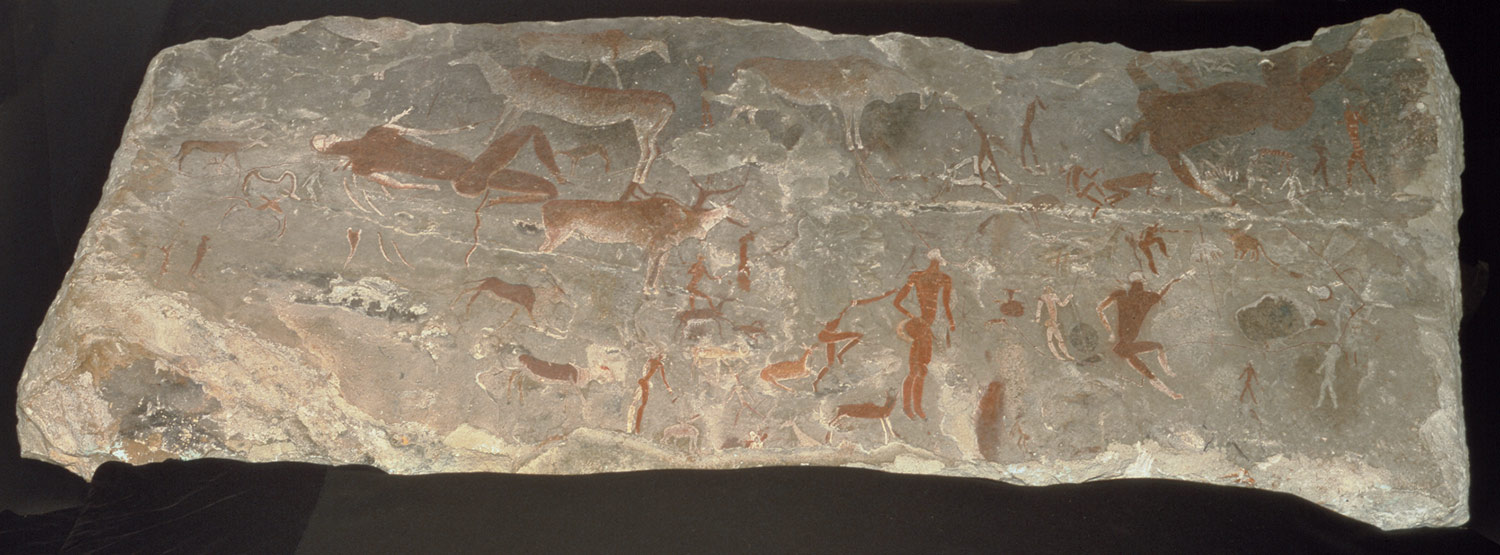
In the Drakensberg Mountains of South Africa, a number of rock paintings depict clashes between San (Bushmen) people and European colonists mounted on horses and armed with rifles. Many of the Drakensberg works use subtle polychrome shading that gives their subjects a hint of three-dimensional presence.

pstrongThe Linton Panelstrongbr Image courtesy of the South African Museum Cape Townp
The Linton Panel
Image courtesy of the South African Museum, Cape Town

The product of many authors, time periods, and cultures, the flowing naturalism and lively sense of movement of the best rock art attests to the conviction of masterful hands and trained eyes.

Article courtesy of: Department of the Arts of Africa, Oceania, and the Americas. “African Rock Art.” In Heilbrunn Timeline of Art History. New York: The Metropolitan Museum of Art: http://www.metmuseum.org/toah/hd/rock/hd_rock.htm (October 2000)


Saturday, September 29, 2012

The Asante Akua'ba Doll

ASANTE (ACHANTI, ASHANTE, ASHANTI) Ghana

The Asante Akua'ba Doll
Asante akua’ba
The legend of the origination of the Akua'ba doll comes from the story of a woman named "Akua" (many variations of the name are found as there are many variations of the spelling of "akua'ba") who could not get pregnant and went to a local diviner or priest and commissioned the carving of a small wooden doll. She carried and cared for the doll as if it were her own child, feeding it, bathing it and so on. Soon the people in the village started calling it "Akua" "ba" - 
meaning "Akua's child", since "ba" meant child. She soon became pregnant and her daughter grew up with the doll.

The legend and tradition still live on today...

If an Akan/Asante woman had difficulty conceiving she would be encouraged to visit a local shrine accompanied by a senior woman in her family. There she might purchase a figure such as this, which would be placed for a period on the altar, later to be reclaimed by the woman along with certain medicines. The sculpture was then carried, fed, bathed, and otherwise cared for by the woman as if it was a living baby. It was thought that in doing this the woman would have a better chance to have a healthy and beautiful baby. Once the woman conceived and had a successful delivery, she would return the figure to the shrine as a form of offering. If the child died, the akua’ba might be kept by the woman as a memorial.

The symbolism of these dolls is specific: “The flat, disk like head is a strongly exaggerated conception of the Akan ideal of beauty:


The Asante Akua'ba Doll
Asante akua’ba doll (Ghana)
Round or oval shaped heads are considered ideal and this is accomplished in actual practice by the gently modeling of an infant’s soft cranial bones. The flat profile of these figures is also more practical when they are carried against the back wrapped in the woman’s skirt. Also standard is the ringed neck, a convention for rolls of fat and hence 
beauty and prosperity…the small scars seen on the faces of many akua’ba are those made for medicinal purposes as protection against convulsions. Most Asante akua’ba have abstracted, horizontal arms and a cylindrical torso with breasts and a navel, but ending in a base rather than human legs.

Sources: Sotheby's, AFRICA - The Art of A Continent, The Royal Art of Africa, and 


Saturday, September 08, 2012

African Maternity Figures

Akan brass maternity figure on stool
In almost all African societies, the most important role of women is to bear children. Whatever else – farming, cooking, or their role in women’s associations – their primary responsibility is to produce and nurture children. 

It is, as Cole puts it, a “biological imperative” or, as Dennis Warren states, “cultural duty" (1974, 2.37). Indeed, certain groups, such as the !Kung, "do not consider a marriage consummated until the birth of a child" (Fried and Fried 1980, 29).

"A person who has no descendants in effect quenches the fire of life, and becomes forever dead since his line of physical continuation is blocked if he does not get married and bear children" (Mbiti 1969, 133).

Unhappy is the woman who fails to get children for, whatever other qualities she might possess, her failure to bear children is worse than community genocide: she has become the dead end of human life, not only for the genealogical line but also for herself. . . . the childless wife bears a scar which nothing can erase. She will suffer for this, her own relatives will suffer for this: and it will be an irreparable humiliation for which there is no source of comfort in traditional life.

In such a setting, it is not surprising to find great numbers of images of women with children in Africa. The earliest known are several terracottas from Nok in northern Nigeria possibly dating as early as the sixth century B.C. Bernard Fagg writes, "There are two or three pieces, and the frieze of figures . . . which may possibly be representing the concept of motherhood" (1977, 38). The frieze has "repetitive modelling of what is probably a 'mother and child' 
motif".

Images of women holding children may reflect a number of ideas, for example, they may represent ancestors and serve as "symbols of lineage or clan forbears, the generalized and incarnate dead" (Cole 1985, 8). It can only be conjectured that the Djenne example with its "mother" and adult "children" may be an instance of such a meaning.
Afo Maternity Figure (Nigeria 19th Century) wood
Afo Maternity Figure
(Nigeria 19th Century) wood

In most cases, the child or children are not identifiable; indeed, they are often amorphous or even caricatural in form. William Fagg refers to the "unwritten law on the portrayal of mothers and children in sculpture, a law so general that it must surely have a philosophical basis. This is the rule that children are not given a personality or character of their own, but are treated as extensions of their mother's personality" (in Vogel 1981, 1x4).

Others, such as Vogel, note: Because children are not fully "civilized" (or socialized), productive members of society, their depiction in art makes little sense. Infants, in contrast, often appear in a secondary role, representing the productivity of the mother. To cite a parallel from life, one often sees a woman dressed up and carrying a child (not necessarily her own) as a sort of costume accessory. A woman looks better with a baby. (1980, 13)

Thus we come at once to a major contrast between African maternity images and Christian images of Mary and the Christ child. In the latter, the primary focus is on the infant, and the mother is definitely a secondary figure. This is clearly the reverse of the roles of child and mother in African examples. The child, as a symbol of maternity, supports and reinforces the role of the mother as genetrix for the family and the group.

Examples are known where the mother is standing , kneeling, or sitting; the child may be suckling or may be held on the lap or carried on the back, and there may be more than one child. In contrast, scenes of birth are rare, and the rituals surrounding birth rarely make use of sculpture.


Akan Maternity Figure - Ghana -Mid-late 20th century
Akan Maternity Figure - Ghana
Mid-late 20th century
Henry Drewal (1978, 564) has pointed out that among the arts of the Yoruba, "Mothers shown nursing or carrying children represent the long weaning period (approximately two years), a time of sexual abstinence and suppressed menstruation . . . which is seen as a state of purity or ritual cleanliness." 

Elsewhere he states, "Pregnant and nursing women achieve a state related to that of elder women," who are past menopause and therefore free of the pollution of menses. Thus mother and child images denote a state of natural purity; for during the long nursing period . . . when the child is carried on the back, a woman's menstruation is suppressed and she practices sexual abstinence. . . . Thus images of women in ritual contexts and mother and child figures represent much more than symbols of fertility. They communicate sexual abstinence, inner cleanliness, ritual purity, female forces and spirituality.

Some Yoruba figures are shown kneeling, "a position of respect, devotion, and even submission to the gods. This posture is appropriate [because] most women in Yoruba sculptures represent royal wives or worshipers, not gods themselves" (Cole 1985, 19).

It is evident that although the specific meaning of images of maternity may vary from group to group and be associated with nature deities, ancestors, the group genetrix, or divination, they all ultimately and surely refer to human fertility and the future of the group that is grounded in that fertility.

There are images that are specifically approached when a woman wants to conceive. Such images are found on Yoruba doors or as shrine images in Ghana in the town of Anyinabrem where the sculpture of a mother suckling a baby was visible and, "when barren patients come to the shrine and see this statue they know the god can help them to get a child" (Warren 1974, 386).

Much more common in southern Ghana among several groups are akua'ba images, which are believed to relate directly to human fertility. These may be used by a priestess, as Warren reports (ibid., 388), to help barren women have children, or they may be carried by a woman after she conceives to ensure that she will have a healthy and handsome child. Others, quite similar in form, may help a woman "keep" a child that has been born several times but has not lived. It is believed that the intervention of the fertility deity will ensure a successful birth.

Roy Seiber
From: African Art in the Cycle of Life
Article from the Rand African Art website - Denver, Colorado