Showing posts with label african art. Show all posts

Monday, February 13, 2017

The African Maternity Figures

Afo peoples, Nigeria, 19th century
(wood)
Since the 1940s, the excavations in the inland delta region of the Niger River near Djenne in Mali have yielded numerous sculptured terra-cotta, cast copper-alloy, and gold figures representing humans and animals. These sculptures originated in advanced, flourishing cultures that may have existed as early as the eighth century A.D. or as late as the seventeenth century.

Figures representing a mother and child seem to occur less frequently than other subjects, such as chiefs or warriors on horseback, reclining or kneeling females, or animals, especially snakes. The meaning of these ancient maternity figures is unknown. Perhaps such figures served as symbols of the primordial mother or another mythical figure in the history of a clan in which the sculpture originated. Regrettably, the stratigraphic context in which most of these objects have been discovered and other pertinent data are unknown. Even so, it is possible to date the objects.

The proliferation of decorative details on the figure includes serpents, which are depicted as zigzags. Snakes commonly occur in the visual arts as well as in the oral traditions of numerous peoples of the inland delta region. Snakes play an important role in the cosmology and mythical origins of the clan. For example, snakes are king makers, designating the successful candidate by touching him with the nose. Snakes are often considered to be symbols of immortality throughout sub-Saharan Africa because they "renew" themselves by shedding their skin.

Asante group, Akan peoples, Ghana
19th-20th century (wood)
Fertility and children are the most frequent themes in the wooden sculptures of the Asante. Thus the most numerous works are akua'ba fertility figures and mother-and-child figures. In traditional Asante society, in which inheritance was through the maternal line, a woman's essential role was to bear children, preferably girls to continue the matrilineage. Sculptured mother-and-child figures show the mother nursing or holding her breast, as exemplified by this figure. Such gestures express Asante ideas about nurturing, the family, and the continuity of a matrilineage through a daughter or of a state through a son.

This figure does not depict an ordinary mother. Rather, as indicated by her elevated sandaled feet, the figure represents a queen mother as she would sit in state on formal occasions. Such royal maternity figures were kept with the venerated seats of ancestral chiefs in special rooms, or they were housed in the shrines of powerful deities that were particularly concerned with the well-being of a royal person, perhaps a queen mother.

According to Yoruba belief, children are blessings from the gods. Before the advent of modern medicine, women petitioned certain deities for fertility and the birth of a healthy infant. The shrines to these deities - Erinle, Yemoja, Shango, Ogun, and others - were adorned with sculptured figures representing a mother and child, as exemplified by this figure. The absence of cult attributes makes specific identification of this figure impossible. The kneeling position is a gesture of respect, devotion, and submission. Thus the figure represented in the carving is probably a petitioner rather than a deity. The sculpture may have been a votive offering from a woman who had successfully petitioned for a child, a priest or priestess of a cult, or even the entire body of
worshipers.

Afo maternity figures are thought to represent an ancestral mother and are owned by individual villages.These figures are brought out of their shrines once a year for the Aya ceremony. At this time, men pray for increased fertility in their wives and make gifts of food and money to the ancestor.

Extant maternity figures from the Afo are usually monoxylous, that is, carved from one piece, and are usually shown with only one child. It was customary in the grasslands Batufam Kingdom to have portrait statues carved of the new fon (king) and the wife who bore his first child. According to royal custom, the heir to the throne could not rule until he proved his fertility. The sculptures were executed within two years of the beginning of the reign and were used in the rites of installation of the successor.

Female figure with child
Kongo people, Congo
(wood)
The Kongo Kingdom flourished from c. 1300 to the mid-seventeenth century. The Kongo were the first people of Central Africa to make contact with the Portuguese navigators, who first arrived in 1482 and brought with them Catholic missionaries, merchants, and artisans. The Kongo aristocracy embraced Christianity and Western culture, and trade with Portugal resulted in increased wealth and military power. From the capital at Sao Salvador in present-day Angola, Kongo rule extended into portions of Zaire, Congo, Cabinda, and numerous small coastal and inland chiefdoms in Angola. Around the mid-seventeenth century, the once-powerful kingdom began to founder and shrink. Finally, it collapsed and became decentralized.

Among the symbols of rank belonging to Kongo kings and chiefs were scepters (mvuala) made of hardwood and usually topped by an ancestor figure carved of precious ivory. Very often the ancestor so represented was a female (Cornet 1971, 48). Because power was transmitted through the female line, rulers were selected from among the matrilineage. The king's mother was titled the "queen mother," and although she did not share rule with her son, she held a position of respect and privilege.

Article and images, courtesy of Rand African Art 

A Kongo-Yombe Maternity Figure has recently been sold for US$ 3,525,000 by Sotheby's... 
What's In Your Attic?


Thursday, January 26, 2017

The Dogon of Mali Way Of Life

A Dogon Mask
Courtesy of: http://www.hamillgallery.com
Dogon statues are conserved in the semi darkness of sanctuaries or of family homes. These objects are made to be touched rather than seen. Occasionally offerings and sacrifices are made to them. The statues are made by a blacksmith, who, if he has talent can create true works of art. The masks are sculpted by non specialists during the course of a ritual that takes place outside of the village.

Dogon style has evolved towards a type of cubism with ovoid heads, square shoulders, slender limbs, pointed breasts, forearm and thighs in the same parallel plane, and a coiffure stylized by two or three incisions. Dogon statues express in particular religious values and feelings. They act as a support to initiation rituals and in explaining the world.

The Dogon live in the south of Mali, a region which is made up of plains, a plateau and above all an escarpment. The Bandiagara escarpment is 260 km long and overhangs the plains. The Dogon cultivate millet, sorgho, fonio, rice and durum wheat at the edge of the cliffs and near the rare water points. They are not the first inhabitants of this region. The Dogon say that they came from Mande, or the Ancient Mali Empire to escape from Islamization. They probably started their migration between the 10th and 13th centuries and chased the Tellum from the cliffs. The memory of the Tellum is conserved in grain stores at the foot of the cliffs and rocky cavities where their dead were buried along with the statues.

Dogon Religion

Before the world was created, there was a God called Amma who had the appearance of an egg. Amma created four male and four female creatures. The males are: Nommo Die, Nommo Titiyayne, O Nommo and Ogo and were created in the form of fish. But Ogo rebelled before he was fully finished, as he wanted to make the creation his own. O Nommo was sacrificed to pay back the error of his twin Ogo and came down to earth in the ark that carried men’s ancestors and all living beings. Ogo, rebelling against Amma, detached himself from Amma’s placenta, ripping part of it away, and came down to earth with the ark.

In leaving Amma’s womb prematurely, he did not wait for the full gestation of his twin. He found himself weak and alone because Amma had transformed the piece of placenta torn out by Ogo, into our earth and the moon. Ogo, displeased with the earth, unfit for cultivation, went back up to the sky to interrupt Amma’s work and to retrieve the remains of his placenta. But Amma, wanting to put this piece of placenta out of Ogo’s reach, transformed it into our sun. Next, Amma transformed Ogo into a four legged creature, a pale fox that from that moment on would be the instrument of chaos in the universe. In accepting the opposition of the fox, and the chaos that he brought to the universe, Amma allowed psychological dualism and individualization to be created. In order to reorganize the universe that had been disturbed by the fox, Amma decided to sacrifice her twin brother O Nommo. His blood served to purify the earth and his body, cut into pieces, allowed the stars, the animals and the plants to appear. After this purification of the universe, O Nommo was brought back to life and sent back to earth by Amma, to give birth to humans and to reorganize life on earth. Amma had made men immortal, but following the chaos brought by the fox to the earth, death appeared. The ark in which Ogo had come down to earth became uncultivated land, and that of O Nommo the symbol for cultivated land. After all the beings had descended from the ark, O Nommo (or Nommo) returned to  his fish like form and went to live in the great expanse of water (the oceans) that had been born of the first rainfall. It is in the water that Nommo reveals to man the words woven through his teeth.

The Dogon religion is made up of the belief in Amma, distant and immaterial God, but which is realized through institutions and ongoing actions towards the ancestors:

1° The cult of the immortal totemic ancestors.

2° The Lebe cult, a great ancestor who died and was brought back to life in the form of a snake. Lebe is the great ancestor whose sons gave birth to the four tribes: Dyon, Dommo, Ono and Arou.

3° The mask cult, mortal ancestors.

The Dogon Economy

The Dogon are farming people, with a system of patrilineal descent and patrilocal residency. There is a division of labour. The men cultivate the fields and hunt albeit for a meager result (because of the lack of game) weave and make basket work. The women take care of the home, make pottery, spin cotton and dye fabric. The blacksmith doesn’t only work metal he also makes objects out of wood. He is an important person and belongs to a caste.

Social Organisation among the Dogon and Initiation rites

Comprising several totemic clans, the Dogon village comes under the authority of the council of elders. The clans are subdivided into lineages, led by the patriarch, the guardian of the ancestral altar and responsible for the cult.

There are other broader communities than the clan, these are the four initial tribes (Dyon, Arou, Ono, Dommo) each the respective descendant of the four mythical ancestors (Amma Serou, Libe Serou, Binou Serou, Dyongou Serou). In the beginning, they should have shared the Dogon country between them, but they were finally integrated into the same territory. It is at the heart of these tribal proceedings that the ‘Hogons’, or highest religious dignitaries and heads of a region, are named. They are in charge of the cult of the mythical snake Lebe and the cult of the ancestor Lebe Serou. Aided by the blacksmith, they preside over agrarian ceremonies. Masters of exchange and commerce they do not work the land and cannot leave their house, considered as a sanctuary. The supreme Hogon is the one that resides at Arou.

In correlation to this hierarchical relationship there is also a system of grouping by age, whereby the members mutually owe each other lifelong help and assistance.

Circumcision and excision open the door to adulthood and allows young people to marry and participate in social and ritualistic life.

Masculine and feminine associations are responsible for the initiation which is carried out by age group. Members of each age group owe mutual and lifelong help to the other members of the group. A boy’s initiation begins after his circumcision. This begins with teachings of traditional myths, taught through the medium of drawings and paintings. The boys learn man’s place in nature, society and the universe. Dogon mythology is so complicated that a griot would need a week to tell it in its entirety.

Blacksmiths and wood carvers form a separate caste. Their trade is mainly passed down from generation to generation. They are feared and respected by the community who attribute particular powers to them. They can only marry inside their own caste. The women take care of the pottery.

Great Dogon Ceremonies

The masculine association or ‘Awa’ is responsible for initiation and equally organizes the great ceremonies that take place at the end of the mourning period. This period can last for several days and recalls the memories of people that have died within the last two or three years. Two main types of mask are made for these occasions:

The ‘Sirige,’ or house with several storeys, is worn by a dancer who mimics the myth of creation and the descent from the ark. The Kanaga mask is crowned by a cross indicating the skies and the earth. They are accompanied by other types of zoomorphic masks: antelope, hyena, lion, hare, monkey, buffalo, bird, as well as other helm masks embellished with horns and a muzzle. These masks might be decorated in red, black or white.

The grand Sigui ceremony takes place every 60 years. It is symbolized by a snake mask, and everyone in the community takes part in the event.

Dogon Sculpture

Dogon sculpture is conserved in the semi darkness of sanctuaries or of family homes. These objects are
made to be touched rather than seen. Occasionally, offerings and sacrifices are made to them.

The masks are sculpted by non specialists during the course of a ritual that takes place outside of the village. The statues are made by a blacksmith who, if he has talent, can create true works of art in his house situated in a quarter reserved especially for professionals who work under the watchful eye of the population. The quality of the work also depends on the wealth of the person who commissions it.

In this region of Mali, it is important to recognize the works of art that were made by the Tellum, the predecessors of the Dogon, who occupied the area in the 11th and 12th centuries.

The main theme of the statues is the sacrifice of Nommo. The statues are created from a wood that is thought to be hard and powerful.  They follow the relationship of Nommo and Amma at various periods of their lives.

The signification of the different representations is mainly as follows:

If the statue has one arm raised up it symbolizes the relationship between O Nommo and Amma before his sacrifice, but also of his role as the organizer of the world. Sometimes, he is hermaphrodite because Nommo is bisexual. When both arms are raised but separated, Nommo is praying to Amma to allow him to stay with her after his resurrection. If both arms are raised and joined together, Nommo is praying for Amma to come to him and protect him. When both arms are raised with the hands together and the palms facing up to the sky, Nommo is imploring the rain to fall. When both arms are down by the sides this position symbolizes Nommo’s descent to earth. With both arms spread out away from the body and with the palms facing forward, Nommo reveals his role of guardian of space. If Nommo has both hands placed on his thighs this means that he is relying on Amma.

Throughout these different representations, the face is often very smooth signifying that the world must remain clean and organized like a smoothly shaved face.
A couple of primordial ancestors.
Courtesy of http://www.hamillgallery.com

The figure of a man’s statue incorporates traits that are the essence of Dogon sculpture. They translate the monumentality that is obtained through a strict use of volume, reducing the physiognomy down to the essential (without superfluous detail), disturbing the serious face of the character with its long and extremely triangular nose.

A couple of primordial ancestors, sitting side by side share the same characteristics. The faces are harsh and the rigidity of the pair is only broken by the gesture of tenderness of the man putting his arm around his companion’s shoulder.

Again, the same characteristics apply for a statue of a woman sitting on a stool decorated with sculptures of the ancestors. The coiffure of the seated woman is more heavily refined, but the principal traits of the face are schematic: diamond shaped eyes, rectilinear nose in the form of an arrow, slit mouth. Sculptures of women with children are treated in the same austere and monumental manner. A woman crushing seeds is sculpted in the same synthetic manner, without any anecdotal features.

Xylophone or balafon players are treated in the same hieratic way, full of nobility and severity.

A great number of figures recall that Nommo pulled the ark towards a hollow filled with water by changing himself into a horse.

  • The Dogon create hermaphrodite, ‘Tellum type’ statues where the arms are raised and which are covered with a thick patina of blood and millet beer.
  • The four Nommo couples, mythical ancestors born of the God Amma, decorate stools, the columns of the men’s meeting houses, as well as locks and barn doors.
  • The primordial couple is represented sitting on a stool, of which the base represents the earth and the top tray the sky. Between the base and the tray Nommo is figured, the ancestor of all humans.
  • The feminine seated figures, with their hands on their stomachs, are linked to the fecundity cult and are the incarnation of the first dead ancestor that died in childbirth. They are the object of offerings and sacrifices made by pregnant women.
  • The kneeling statues of the protecting ancestors are placed next to the deceased’s head in order to absorb his spiritual force. They play an intermediary role with the afterlife by accompanying the deceased. They are then returned to the ancestral altars.

Dogon style has evolved towards a type of cubism with ovoid heads, square shoulders, slender limbs, pointed breasts, forearm and thighs in the same parallel plane, a coiffure stylized by two or three incisions. Dogon statues express in particular religious values and feelings. They act as a support to initiation and as an explanation of the world itself. Hidden in sanctuaries or in the Hogan’s dwelling, they act as vectors of knowledge for the initiate who will learn how to interpret the signs of the statue depending on his level of knowledge.

Dogon art also manifests itself in architecture, and both cult and domestic objects.

Dogon blacksmiths also make ritual irons showing Nommo in various stances and situations as for the statues, but along with some fish like elements.

Article courtesy of African-Art.net
Images courtesy of HamillGallery.com  

Tuesday, January 17, 2017

The African Passport Masks

This beautiful passport mask certainly contains Kaba Ko - an African term referring to marvellous things that can be looked upon without limit.

Bassa Miniature Mask
Liberia
African Masks are sacred objects. These passport masks functioned as a medium of communication between a person and their favoured ancestor. In their original context, miniature masks were integrated into a system of belief in which they functioned as spiritual guides and personal protectors.

The Dan believe that their world is split into two domains: the human domain which is represented by the village and its people, and the spiritual domain which is represented by the forest and its spirits.

These miniature masks were often carried for personal protection when living away from home, and in later years they were commonly understood to also function as a means of tribal identification. Asan Diop, of Abidjan, describes the role of passport masks:

Before Whiteman brought paper and pen to Africa, these small masks were the only form of identification that we Africans could carry with us. Each person owned a carving of himself and each tribe had its own kind of masks. This is the only way people could cross the frontier between tribal groups.

In a culture where hierarchy was based upon skill, carvers were highly respected. The masks were generally
Dan Miniature Mask
Liberia/Ivory Coast 
carved from a local rubber tree and always dyed either black or brown. This was done according to a long and delicate process to which the Bassa artist remained faithful, using colour obtained by the decoction of forest leaves.

Respected carvers would not sand the surface, but instead use their blades obliquely over and over again, generally lifting off shavings invisible to the layman's eye. The masks often acquire celebrated 'natural patina', from their exposure to the elements or frequent handling.

The beautiful depth of patina and the marvellous ability for such a small figure to attract one's attention further emphasises the mystery and power of this ''passport''.

Article courtesy of FHE Galleries: http://www.fhegalleries.com/ethnological/showArticle.php?file=04_23_africandanpassportmask.xml&year=2013
Images courtesy of the hamillgallery.com


Used Old Jar Sold For $51,000 On eBay... What´s In Your Attic?


Friday, January 06, 2017

African Batik Art


The art of batik or wax painting is an ancient craft and technique used in Africa and many East Asian countries for decorating fabrics. The batik images or effects are achieved through the principle of wax and water repelling each other, called resist dyeing.

The artistic expression of working with melted wax on dyes is similar to that of painting with watercolor, oils or acrylics and the designs can be as complicated or simple as the artist's desire.

Since batik is a method of painting "negative space", the artist has to envision the complete design in-between shapes and figures when deciding where to apply the next color and the next application of wax.

Wax is painted on to the fabric and the color is filled into the fabric between the wax. The most popular ways of applying wax are either by painting it on with a brush or by pouring the liquid wax on the cloth. With a series of dyeing, drying and waxing steps the individual colors of the batik are applied.

After the last dyeing, the fabric is hung up to dry. Then it is ironed between paper towels or newspaper to absorb the wax and reveal the vibrant colors and fine crinkle lines that give the batik its character.

African batiks are unique pieces of art handcrafted by talented artisans. If you like to decorate with textiles or showing off your love for unique fabrics, then African batiks are definitely for you.

From home decor to quilting and other crafts, batiks will enhance any project with true African flair. Frame a batik, transform a batik into a wall hanging by simply stretching it with bamboo poles, make a pillow case out of batiks, decorate a handbag, make a lamp shade or incorporate a batik into your quilting project.

Let the batik speak for itself and let the beauty be in the eye of the beholder.

Article and image courtesy of World Travel Art - Great selection of African batiks from Mozambique and Tanzania.


Thursday, January 05, 2017

African Rock Art

Image courtesy of
Dr. Katherine Bolman
Ahaafoundation, Honolulu, Hi 96822
Rock paintings and engravings are Africa’s oldest continuously practiced art form.

Depictions of elegant human figures, richly hued animals, and figures combining human and animal features—called therianthropes and associated with shamanism—continue to inspire admiration for their sophistication, energy, and direct, powerful forms. 

The apparent universality of these images is deceptive; content and style range widely over the African continent. Nevertheless, African rock art can be divided into three broad geographical zones—southern, central, and northern. 

The art of each of these zones is distinctive and easily recognizable, even to an untrained eye.

Not all rock art in these three zones is prehistoric; in some areas these arts flourished into the late nineteenth century, while in other areas rock art continues to be made today.

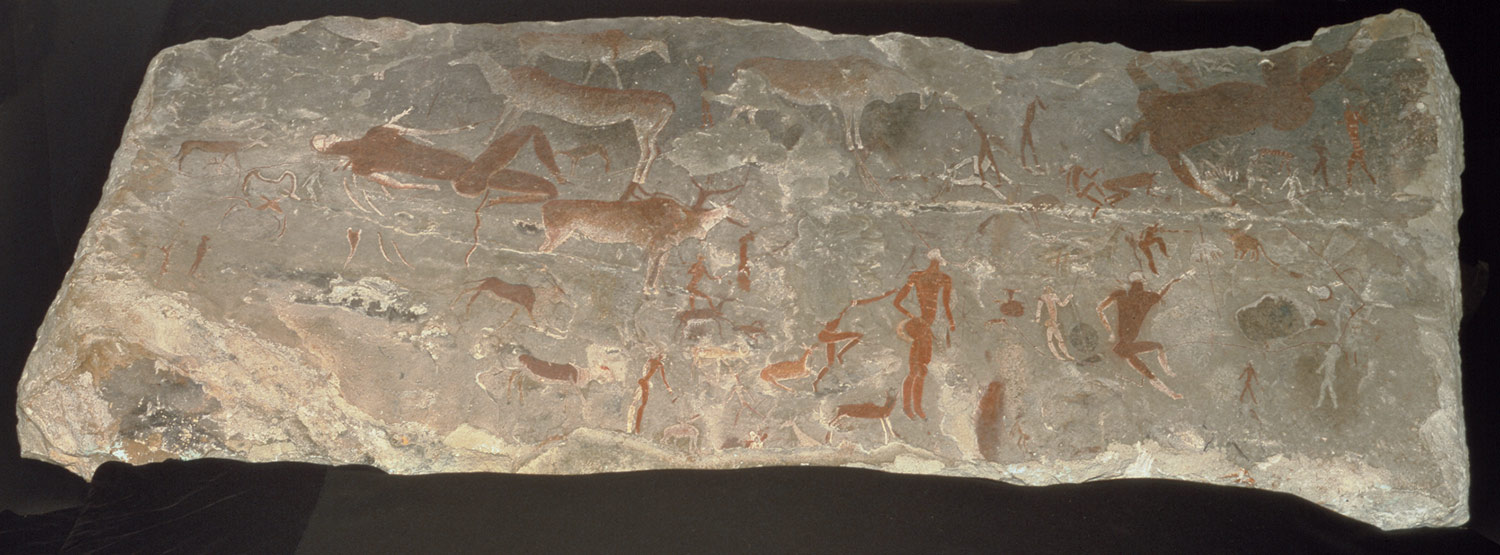
In the Drakensberg Mountains of South Africa, a number of rock paintings depict clashes between San (Bushmen) people and European colonists mounted on horses and armed with rifles. Many of the Drakensberg works use subtle polychrome shading that gives their subjects a hint of three-dimensional presence.

pstrongThe Linton Panelstrongbr Image courtesy of the South African Museum Cape Townp
The Linton Panel
Image courtesy of the South African Museum, Cape Town

The product of many authors, time periods, and cultures, the flowing naturalism and lively sense of movement of the best rock art attests to the conviction of masterful hands and trained eyes.

Article courtesy of: Department of the Arts of Africa, Oceania, and the Americas. “African Rock Art.” In Heilbrunn Timeline of Art History. New York: The Metropolitan Museum of Art: http://www.metmuseum.org/toah/hd/rock/hd_rock.htm (October 2000)


Friday, September 25, 2015

Art and the Fulani/Fulbe People


Bowl, Geometric Pattern,
19th–20th century; Fulani

Fulani people; Mali, western Sudan
Above all, Fulani people are known for their mastery of verbal art expressed in song and poetry.

Fulani nomads do not change their fashion as frequently as other sedentary groups, thus traces of past aesthetic traditions tend to be perceptible in contemporary times. Fulani often entrust members of specialized castes or foreigners with the fabrication of their objects. Thus, the label "Fulani art" reflects ownership and not manufacture. Leather amulets, knife handles, sheaths, and sandals are decorated with geometric designs that reflect Fulani symbolism and bear the influence of Tuareg and Berber aesthetics. Objects are tinted in bright colors of red, yellow, or white and green, and often feature long fringes. Some of the designs are cross ethnic: the zigzag bordered by parallel lines, for instance, is shared by Fulani and Dogon alike.

Fulani aesthetic expression is, with exceptions, inscribed on objects or sites of an ephemeral nature. Above
Textile Blanket (Khasa), 20th century; 
Fulani people; Mali, western Sudan
all, Fulani people are known for their mastery of verbal art expressed in song and poetry. They are also renowned for their elaborate art of body adornment. Men and women alike are fond of tattooing. They wear amulets (lohol) as both protective and decorative elements. Women wear heavy twisted gold earrings (dibi), gold necklaces (caaka), and copper or white metal bracelets, round or open with bulging extremities, and delicately engraved with dotted lines. Blacksmiths used to make heavy and thick anklets that gave young Wodaabe women a "cowlike" step, much appreciated in this herders' culture. Women from other Fulani groups wore copper or brass leg ornaments or anklets made by the lost-wax casting process. These rings might once have served as currency.

Men's clothing includes a conical herdsman hat—in red, black, and natural color—made of woven raffia and leather, with geometric design in the form of a cross, complete with a prominent button, the "Mount of the world." Men also wear leather or baggy fabric pants, and use woven blankets with geometric patterns. Wodaabe people are famous for organizing male beauty contests, know as yaake or gerewol.

Fulani women, who are in charge of building the family tents or temporary shelters, weave wall and floor mats. Besides nomadic architecture, they specialize in the decoration of calabashes and wooden bowls (la'al kosam). Calabashes are pyro-engraved with a combination of abstract and figural motifs and colored with pigments. In the cow-centered Fulani culture, milk bowls are also important objects for the household. They are used as storage containers for fresh, curdled milk and grains. An artifact, symbol of the pastoral life and of the cooperation between men who keep the herd and women who milk the cows, the la'al kosam encapsulates Fulani identity. Because of their delicate chiseling, smoke-derived patina, and exquisite decorative treatment, bowls and calabashes could be considered as the true focus of aesthetic efforts of the Fulani people.

Citation. Department of Arts of Africa, Oceania, and the Americas. "Art and the Fulani/Fulbe People". In Heilbrunn Timeline of Art History. New York: The Metropolitan Museum of Art. http://www.metmuseum.org/toah/hd/fula/hd_fula.htm


Friday, September 14, 2012

The Baga Nimba at the Metropolitan Museum of Art in NY

Headdress, 19th–20th century
Baga peoples; Guinea
Wood; H. 46 1/2 in. (118.1 cm)

The Michael C. Rockefeller Memorial Collection, Bequest of Nelson A. Rockefeller, 1979 (1979.206.17)

This colossal wooden headdress, measuring nearly four feet in height, is known as D'mba among the Baga peoples of the Guinea coast. D'mba's flat, pendant breasts are a symbol of motherhood and reveal the selfless dedication with which she has nursed numerous children to adulthood. Her coiffure consists of intricately braided rows of hair and a high crest down the center. 

This hairstyle is not a characteristic of the Baga, but rather one of the Fulbe people, who inhabit the Futa Jallon mountains, where the Baga ancestors once lived. 

The coiffure serves as a reminder to the Baga of their origins in the Futa Jallon. The face, neck, and breasts of the bust are decorated with linear patterns: a horizontal line from the cheek to the ear, a curved line from the ear along the jawline, a line connecting these two lines, all ending at a circular line that surrounds the entire face. Often on each cheek, just below the eyes, there are two short carved lines—the mark of Baga ethnicity. Embellishments are sometimes added as well, including painted wooden ornaments attached to the ear or pendants attached to the nasal septum.


Shoulder Mask (Nimba) Guinea
Late 19th -early 20th century
Wood 45 in. (114.3 cm)
Unlike masked representations from other African cultures, which may represent ethereal spirits or ancestors, D'mba is not a "spirit," but instead is loosely described by the Baga themselves as simply an "idea." D'mba is an abstraction of the ideal of the female role in Baga society. She is honored as the universal mother and is the vision of woman at the zenith of her power, beauty, and affective presence. Although D'mba is not a spiritual being in the Baga sense of the term, nor a deity, she is a being of undeniable spiritual power. The Baga conceive of D'mba as a servant of sorts—inspiring young women with the strength to bear children and raise them to adulthood, inspiring young men to cooperative excellence in agriculture, and inspiring the ancestors to contribute toward the continuance of community well-being.

During performances, the massive headdress is worn with a costume of raffia and cloth. In the past, the D'mba masquerade was performed at least twice a year before the rainy seasons. D'mba would also appear to dance at festive occasions such as marriages and funerals, and in honor of special guests. In contemporary Baga culture, D'mba performances have not been as widely embraced as in the past, so they are rarely witnessed today.

The origins of the D'mba headdress, like many other aspects of Baga material culture, remain the subject of conjecture. Most Baga elders suggest that D'mba was not brought by their nomadic ancestors, but rather created after their arrival to their current home in Guinea's coastal region. Interestingly enough, the cloth shawl worn by D'mba during performances, usually dark indigo or black, has always been cotton cloth imported from Europe, never of African manufacture. In fact, it seems that many Baga masquerades developed in the twentieth century use European factory printed cloth for the costume.

Source: Metropolitan Museum of Art