Showing posts with label tribal art. Show all posts

Tuesday, February 28, 2017

The Nkondi or Nkonde Nail Fetish

Kongo Oath-taking and Healing Figure
Fetishes were protective figures used by individuals, families, or whole communities to destroy or weaken evil spirits, prevent or cure illnesses, repel bad deeds, solemnize contracts or oath-taking, and decide arguments. A diviner or holy person would activate the statue, using magical substances. Fetishes gained power and were effective because people believed in them.

The nkondi are the most powerful of the nkisi. They were used to identify and hunt down unknown wrongdoers such as thieves, and people who were believed to cause sickness or death by occult means. They were also used to punish people who swore false oaths and villages which broke treaties.

To inspire the nkondi to action, it was both invoked and provoked. Invocations, in bloodthirsty language, encouraged it to punish the guilty party. It would also be provoked by having gunpowder exploded in front of it, and having nails hammered into it. They were also used to literally "hammer out agreements"...with clear implications as to what would happen to people who broke the agreements.

Magic is practiced throughout Black Africa, but there are distinctions to be made among those who participate in it. The witch doctor is seen as someone who undertakes on his own account a personal communication with evil powers - suspected of casting spells, he is feared and rejected as the most dangerous individual in the tribe. The accusation of sorcery is a serious one.

The diviner, or fetishist, operates in principle for the good of all. His help is sought in times of need, for he is seen as the mediator between members of the tribe and all the powers of darkness. For this reason he also acts as healer.

The various attempts to influence the fearsome powers of the supernatural through the mediation of statues or fetishes have acquired particular intensity in the regions round the mouth of the River Congo, home of the Kongo, Yombe and Vili tribes, and this is also the case in the east of Zaire, among the Songye.

Magical objects were for many years little known in Europe, as Christian missionaries working in Africa tracked them down and had them burnt. Certain statues which were brought back to Europe by religious men, allegedly for documentation, were kept in secret and could not be studied. They were much feared for they seemed, even to European eyes, to have real power, a belief almost universally accepted in 17th-century Europe. Olfert Dapper was the first to look dispassionately at these "fetish" objects and to dare to describe them.

Property of the Rosenberg Collection
Recent work has led to a better understanding. They are wooden carvings, either anthropomorphic or zoomorphic, which are covered with a variety of objects such as nails or metal blades. The cavities in their back or stomach contain "medicines" - grains, hair, teeth or fingernails - which are held together with various binding materials. Pieces of fabric, feathers or lumps of clay are sometimes present.

Finally, bits of mirror, shiny metal or shells are used to close the cavities or to mark the eyes. Very often the faces alone are carved in detail, while the rest of the body - destined to be hidden under these various additional features - is sculpted more summarily. The figure's genitals may even be missing, either because they have never been carved or because they have been removed by a zealous missionary.

These figures have only a remote ancestral connection and they are distinguished from reliquaries by the absence of skulls or large bones, although some may sometimes fit into either category.

Generally grouped as Nkisi, they were the result of the combined work of two men, the carver and the fetishist. The former created the shape, but without the latter (the Nganga) the figure had no meaning. It was the Nganga who filled it with magic substances and completed the rituals which gave it supernatural powers.

Article and images, courtesy of Rand African Art 

Nkonde Nail Fetishes are often sold on eBay for around US$ 3,000 to US$ 5,000... 
What's In Your Attic?

https://siterubix.com/?a_aid=05a7f08a

Friday, September 11, 2015

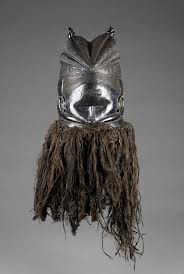
The Mende Helmet Mask "Bundu" or "Sowei" Mask of the Sande Society

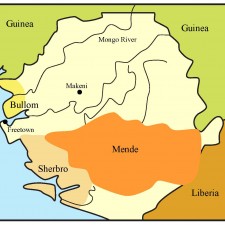
In sub-Saharan Africa only men are normally permitted on ritual occasions to wear wooden masks. This black helmet mask is worn exclusively by women. The practice of women wearing masks seems to have been brought to several populations of  Sierra Leone and Liberia, such as the Temne, Gola and Vai, by the Mende and Mande-speaking people from the northern savanna. Because of the similarity of mask styles and the itinerant pathways of noted carvers, it is difficult to assign some masks to a particular ethnic group.

In the 19th century the Mende were organized into independent chiefdoms; families and individuals were ranked according to their land-use rights. Industrious rice farmers, the Mende number approximately two million people. The rituals of their women's society, called Sande, require the appearance of masked figures. Within such a large population there are many variations in local practices and carving styles, but there is broad agreement on the nature of the mask itself.

The mask presents an ideal of feminine beauty admired by the Mende: elaborate hairstyle, full forehead and small facial features.The gleaming surface signifies healthy, glowing skin. The swelling fleshy rolls alternating with deep incised lines at the neck or back of the head are considered marks of beauty and a promise of fecundity. The neck is broad to fit over the head of the woman who will wear it. Sande officials commission male carvers to produce the mask in secret. The surface is smoothed with the rough leaves of the ficus tree, then dyed black with a concoction made of leaves. Before use, it is anointed with palm oil to make it shine. (Modern carvers use black shoe polish.)

With this confining mask, the wearer (who has to be a good dancer and an official of the Sande) puts on a
thick cotton costume covered with heavy fibre strands dyed black. Her dances may last for over two hours. The sacredness of the mask lies in its deeper meaning as a representation of the long deceased founder of Sande society. In pre-colonial times women could hold the position of chief of a village cluster; until the 1970s women politicians continued to use the Sande society to support and further their careers in modern government. With increasingly rigorous Islamisation, however, the Sande society is being seriously modified or even disbanded.

"The costume worn with the black mask is made of layers of raffia fibers that have also been dyed black. These are attached to the lower portion of the neck as well as to a black cloth shirt or gown worn over the body. The sleeves are sewn shut, and long stockings or men's shoes are worn. No part of the body is left exposed, for revealing the body would expose the human agency behind the mask to the eyes of nonmembers, and would also allow the spirit to enter the human dancer rather than the mask.

Masked dancing provides a festive mood appropriate to the completion of the several stages of initiation. Masks are seen in public at several key moments during the process. Their appearances serve to announce to families of initiates that certain stages have been successfully accomplished and that preparation of foods and gifts of money must be completed. A mask may collect food from the community to take back to where initiation is taking place. She comes into the community to announce the imminent coming out of the girls, and she leads them into town on their first visit after the process has started. Finally, she leads the richly dressed girls into town when they have completed their training and are released. This is the high point of the entire process, for the girls are now recognized as marriageable, adult women.


The mask may appear at other times to bring justice to offenders of Sande law, to perform in respect at the funeral of an important leader of the society, and to participate in ceremonies in which a new mask is initiated into the work of Sande. Nowö is accepted as a living presence. The spirit speaks not through words but through the language of dance, referring to moral and social doctrines of beauty, serenity, dignity, control, order, and balance. Dance movements exaggerate the powers of ordinary women and dramatize the ideals of feminine beauty."

Excerpt above from: Poynor, Robin. 1995. African Art at the Harn Museum: Spirit Eyes, Human Hands. pp. 185-191. Article from the Rand African Art website - Denver, Colorado