Showing posts with label mende. Show all posts

Friday, September 11, 2015

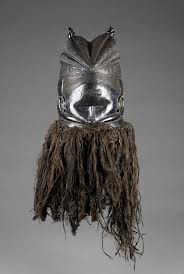
The Mende Helmet Mask "Bundu" or "Sowei" Mask of the Sande Society

In sub-Saharan Africa only men are normally permitted on ritual occasions to wear wooden masks. This black helmet mask is worn exclusively by women. The practice of women wearing masks seems to have been brought to several populations of  Sierra Leone and Liberia, such as the Temne, Gola and Vai, by the Mende and Mande-speaking people from the northern savanna. Because of the similarity of mask styles and the itinerant pathways of noted carvers, it is difficult to assign some masks to a particular ethnic group.

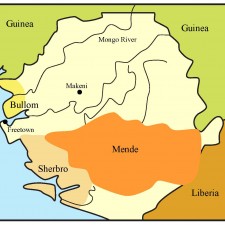
In the 19th century the Mende were organized into independent chiefdoms; families and individuals were ranked according to their land-use rights. Industrious rice farmers, the Mende number approximately two million people. The rituals of their women's society, called Sande, require the appearance of masked figures. Within such a large population there are many variations in local practices and carving styles, but there is broad agreement on the nature of the mask itself.

The mask presents an ideal of feminine beauty admired by the Mende: elaborate hairstyle, full forehead and small facial features.The gleaming surface signifies healthy, glowing skin. The swelling fleshy rolls alternating with deep incised lines at the neck or back of the head are considered marks of beauty and a promise of fecundity. The neck is broad to fit over the head of the woman who will wear it. Sande officials commission male carvers to produce the mask in secret. The surface is smoothed with the rough leaves of the ficus tree, then dyed black with a concoction made of leaves. Before use, it is anointed with palm oil to make it shine. (Modern carvers use black shoe polish.)

With this confining mask, the wearer (who has to be a good dancer and an official of the Sande) puts on a
thick cotton costume covered with heavy fibre strands dyed black. Her dances may last for over two hours. The sacredness of the mask lies in its deeper meaning as a representation of the long deceased founder of Sande society. In pre-colonial times women could hold the position of chief of a village cluster; until the 1970s women politicians continued to use the Sande society to support and further their careers in modern government. With increasingly rigorous Islamisation, however, the Sande society is being seriously modified or even disbanded.

"The costume worn with the black mask is made of layers of raffia fibers that have also been dyed black. These are attached to the lower portion of the neck as well as to a black cloth shirt or gown worn over the body. The sleeves are sewn shut, and long stockings or men's shoes are worn. No part of the body is left exposed, for revealing the body would expose the human agency behind the mask to the eyes of nonmembers, and would also allow the spirit to enter the human dancer rather than the mask.

Masked dancing provides a festive mood appropriate to the completion of the several stages of initiation. Masks are seen in public at several key moments during the process. Their appearances serve to announce to families of initiates that certain stages have been successfully accomplished and that preparation of foods and gifts of money must be completed. A mask may collect food from the community to take back to where initiation is taking place. She comes into the community to announce the imminent coming out of the girls, and she leads them into town on their first visit after the process has started. Finally, she leads the richly dressed girls into town when they have completed their training and are released. This is the high point of the entire process, for the girls are now recognized as marriageable, adult women.


The mask may appear at other times to bring justice to offenders of Sande law, to perform in respect at the funeral of an important leader of the society, and to participate in ceremonies in which a new mask is initiated into the work of Sande. Nowö is accepted as a living presence. The spirit speaks not through words but through the language of dance, referring to moral and social doctrines of beauty, serenity, dignity, control, order, and balance. Dance movements exaggerate the powers of ordinary women and dramatize the ideals of feminine beauty."

Excerpt above from: Poynor, Robin. 1995. African Art at the Harn Museum: Spirit Eyes, Human Hands. pp. 185-191. Article from the Rand African Art website - Denver, Colorado


Monday, August 01, 2005

Kissi Money or ‘Money with a Soul’

At the end of the 19th century, the so-called ‘Kissi money’ or ‘Kissi penny’ was introduced by the Kissi, Loma and Bandi peoples living in the border regions of nowadays Liberia, Sierra Leone and Guinea.

In practice its use was quite extensive. Various sources mention the use of the Kissi money among and between the Bandi, Gbandia, Gola, Kissi, Kpelle, Loma, Mandingo and Mende tribes of this region. Presumably, Kissi money was ‘minted’ as from the 1880s by native blacksmiths who used iron smelted from the rich ore in the region. For many decades Kissi money circulated along with American, British and French paper money.

The shape of the Kissi money is rather odd. Its characteristic form is a twisted rod of iron with flattened ends: a flat, hoe-like spatula at one end and a sharpened ‘T’ at the other. Its length varies from 9 to over 15 inches, the longer ones representing a higher value. Larger ‘denominations’ also were created by twisting several pieces together or bundling them and securing them with a cotton or leather strip. The odd shape may have its origin as a means of protection since it was virtually impossible to tamper with the metal content of the piece without noticing it immediately.

If an iron rod would accidentally break, it could no longer circulate and its value could only be restored in a special ceremony performed by the Zoe, the traditional witchdoctor – often the blacksmith – who, for a fee, would rejoin the broken pieces and reincarnate the escaped soul. Therefore, it was said that Kissi money was ‘money with a soul’.

The Kissi money was a general-purpose currency. Kissi pennies were tied in bundles of twenty and used for a variety of purposes. In the beginning of the 20th century a cow would cost 100 bundles, a virgin bride 200 bundles and a slave 300 bundles.

The French were the first to abolish the use of the Kissi money in their colony. The British followed in 1940. In Liberia things went much slower. In 1936 the District Commissioner at Voinjama, the most northern District of Liberia’s Western Province bordering the French colony of Guinea and the British colony of Sierra Leone, attempted to prohibit the use of Kissi money in payment of the much despised hut tax. Eight years earlier the U.S. Firestone Company had come to Liberia but the company’s operations were concentrated in regions located more to the coast. Since the North American rubber company hardly affected their way of life, the tribal people in the northwestern part of the country continued using the traditional money. It was only after the administrative reform of 1964 and the emergence of modern employers in the 1960s (plantations, iron ore mines), due to President Tubman’s Open Door Policy, that the Kissi money was definitely replaced by the official currency of Liberia - since 1944 the US dollar. In that year President Edwin Barclay had outlawed the British pound and made the US dollar the only legal tender in the country.

After being replaced by Western currencies, the use of Kissi money became virtually limited to ritual ceremonies such as on the occasion of the return of young men and women from the bush schools (Poro and Sande schools) or for sacrifices and divination ceremonies. It also serves for making protective fetishes and to decorate the graves of old warriors. Still many people believe the old money to possess magical powers. Hence, according to many tribal Liberians, the Kissi money still is ‘money with a soul’.

This article is published with the kind permission of Dr Fred van der Kraaij,
and is extracted from his website on the past and present of Africa's oldest republic. Dr Fred van der Kraaij taught economics at the University of Liberia during the second half of the 1970s.

His dissertation on the role of foreign investments in the development of Liberia 1900-1977 was published as “The Open Door Policy of Liberia – An Economic History of Modern Liberia” (Bremen, 1983).

He wrote extensively on West Africa where he lived for over 16 years. Visit his website at: Liberia Past and Present

Saturday, July 16, 2005

The Bundus

SIERRA LEONE– TEMNE, MENDE AND SHERBRO

The largest pieces in the collection were the Bundu Masks which have a fascination for any collector or enthusiast for West African art. They are an integral part of the woman’s society of the SANDE and it is interesting to realise what a strong role women played in the Mende tribal life.

The MENDE tribe number about 700,000 and are the largest ethnic group in Sierra Leone. They are based in the southern part of the country and are ruled by a hierarchy of chiefs having a paramount chief as head of each district. Their economy is based on rice farming.

BUNDU MASKS OF THE MENDE:

The BUNDU helmet masks are worn by the women of the secret society of the SANDE. The women are of the tribes of the MENDE and TEMNE which are found in Sierra Leone and Western Liberia. The style has been continuous for a century but its origins are unclear. It is thought that the first mask was presented to the SANDE society by the water spirit MAMY WATA but it also could have been made by a sympathetic carver who presented the mask to the leader of the SANDE society to prevent her from being recognised.

The purpose of the SANDE is to accompany the young girls on their passage into the adult community. They will supervise their training in the skills required of them anaesthetize the young girls by hypnosis during female circumcision, and sit and receive the gifts presented to the girls by prospective bridegrooms.

When a woman reaches the middle level of the SANDE society, she commissions a mask which will belong only to her and it will project the personality of a certain spirit. The woman will tell the carver only the name of the mask and he will seclude himself in the bush in order to visualise the personality of the spirit. The mask is cut from a log with a machete. The log is then placed in a hole in the ground and the head cavity is dug out with a long handled chisel and a curved blade. Once this is formed, the log is removed from the hole and the centre of the face is marked. From this line the diamond layout of the face is created from the centre point. Symbolism both physical and spiritual is incorporated. If the hair is created in the three lobed setting, maleness is suggested whereas the arrangement of four lobes signify the female concept. The five lobed hair setting is a phallic symbol. The SHERBRO-MENDE carve a seven lobed setting to present the concept of the complete human unit.

The bulging neck is both symbolic and functional with the MENDE equation of corpulence to fertility. When completed, holes are burned around the base of the neckline to which raffia will be attached and the mask is dyed with juice from the leaves of the kojo vine which takes if first to a bright green but later oxidizes to the desired deep brown. Before the spirit can enter the mask, the costume but be completed to cover the entire body.

Black dyed raffia is attached to the mask, a cloth suit with the end of the sleeves sewn closed is worn over long stockings of often shoes are worn to prevent holes in the stockings through which the spirit would enter the dancer rather than the mask.
Once the woman passes through that stage of the SANDE society and moves upwards, the mask is no longer used but may be offered to the chief as a prestige gift, or transformed to represent the comedian GONDE. In some cases, the retired mask will be decorated with strips of silver or some other metal to denote that they are no longer in use. In order to fully appreciate the BUNDU mask, the dancer should be seen in the dipping and twirling motion which brings the mask to life and as with most of the MENDE art, it invites movement and handling in order to fully appreciate the three dimensional aspects.

The NJAYEI MASK which is different from the BUNDU mask by virtue of the spotted markings and simple lines, is worn by members of the NJAYEI society of which both men and women may be members, but they must first be members of the SANDE (female) or PORO (male) society. The head of the society is a woman who’s house is also the spiritual shrine. The mask is used in the control of sexual behaviour and will be used in ceremonies to aid such problems as mental illness, impotence, fertility, self confidence and personality development. The spotted markings on the mask are symbolic of blood which is closely associated with health and fertility, and white markings which are associated with the spirits.