Showing posts with label Nommos. Show all posts

Thursday, January 26, 2017

The Dogon of Mali Way Of Life

A Dogon Mask
Courtesy of: http://www.hamillgallery.com
Dogon statues are conserved in the semi darkness of sanctuaries or of family homes. These objects are made to be touched rather than seen. Occasionally offerings and sacrifices are made to them. The statues are made by a blacksmith, who, if he has talent can create true works of art. The masks are sculpted by non specialists during the course of a ritual that takes place outside of the village.

Dogon style has evolved towards a type of cubism with ovoid heads, square shoulders, slender limbs, pointed breasts, forearm and thighs in the same parallel plane, and a coiffure stylized by two or three incisions. Dogon statues express in particular religious values and feelings. They act as a support to initiation rituals and in explaining the world.

The Dogon live in the south of Mali, a region which is made up of plains, a plateau and above all an escarpment. The Bandiagara escarpment is 260 km long and overhangs the plains. The Dogon cultivate millet, sorgho, fonio, rice and durum wheat at the edge of the cliffs and near the rare water points. They are not the first inhabitants of this region. The Dogon say that they came from Mande, or the Ancient Mali Empire to escape from Islamization. They probably started their migration between the 10th and 13th centuries and chased the Tellum from the cliffs. The memory of the Tellum is conserved in grain stores at the foot of the cliffs and rocky cavities where their dead were buried along with the statues.

Dogon Religion

Before the world was created, there was a God called Amma who had the appearance of an egg. Amma created four male and four female creatures. The males are: Nommo Die, Nommo Titiyayne, O Nommo and Ogo and were created in the form of fish. But Ogo rebelled before he was fully finished, as he wanted to make the creation his own. O Nommo was sacrificed to pay back the error of his twin Ogo and came down to earth in the ark that carried men’s ancestors and all living beings. Ogo, rebelling against Amma, detached himself from Amma’s placenta, ripping part of it away, and came down to earth with the ark.

In leaving Amma’s womb prematurely, he did not wait for the full gestation of his twin. He found himself weak and alone because Amma had transformed the piece of placenta torn out by Ogo, into our earth and the moon. Ogo, displeased with the earth, unfit for cultivation, went back up to the sky to interrupt Amma’s work and to retrieve the remains of his placenta. But Amma, wanting to put this piece of placenta out of Ogo’s reach, transformed it into our sun. Next, Amma transformed Ogo into a four legged creature, a pale fox that from that moment on would be the instrument of chaos in the universe. In accepting the opposition of the fox, and the chaos that he brought to the universe, Amma allowed psychological dualism and individualization to be created. In order to reorganize the universe that had been disturbed by the fox, Amma decided to sacrifice her twin brother O Nommo. His blood served to purify the earth and his body, cut into pieces, allowed the stars, the animals and the plants to appear. After this purification of the universe, O Nommo was brought back to life and sent back to earth by Amma, to give birth to humans and to reorganize life on earth. Amma had made men immortal, but following the chaos brought by the fox to the earth, death appeared. The ark in which Ogo had come down to earth became uncultivated land, and that of O Nommo the symbol for cultivated land. After all the beings had descended from the ark, O Nommo (or Nommo) returned to  his fish like form and went to live in the great expanse of water (the oceans) that had been born of the first rainfall. It is in the water that Nommo reveals to man the words woven through his teeth.

The Dogon religion is made up of the belief in Amma, distant and immaterial God, but which is realized through institutions and ongoing actions towards the ancestors:

1° The cult of the immortal totemic ancestors.

2° The Lebe cult, a great ancestor who died and was brought back to life in the form of a snake. Lebe is the great ancestor whose sons gave birth to the four tribes: Dyon, Dommo, Ono and Arou.

3° The mask cult, mortal ancestors.

The Dogon Economy

The Dogon are farming people, with a system of patrilineal descent and patrilocal residency. There is a division of labour. The men cultivate the fields and hunt albeit for a meager result (because of the lack of game) weave and make basket work. The women take care of the home, make pottery, spin cotton and dye fabric. The blacksmith doesn’t only work metal he also makes objects out of wood. He is an important person and belongs to a caste.

Social Organisation among the Dogon and Initiation rites

Comprising several totemic clans, the Dogon village comes under the authority of the council of elders. The clans are subdivided into lineages, led by the patriarch, the guardian of the ancestral altar and responsible for the cult.

There are other broader communities than the clan, these are the four initial tribes (Dyon, Arou, Ono, Dommo) each the respective descendant of the four mythical ancestors (Amma Serou, Libe Serou, Binou Serou, Dyongou Serou). In the beginning, they should have shared the Dogon country between them, but they were finally integrated into the same territory. It is at the heart of these tribal proceedings that the ‘Hogons’, or highest religious dignitaries and heads of a region, are named. They are in charge of the cult of the mythical snake Lebe and the cult of the ancestor Lebe Serou. Aided by the blacksmith, they preside over agrarian ceremonies. Masters of exchange and commerce they do not work the land and cannot leave their house, considered as a sanctuary. The supreme Hogon is the one that resides at Arou.

In correlation to this hierarchical relationship there is also a system of grouping by age, whereby the members mutually owe each other lifelong help and assistance.

Circumcision and excision open the door to adulthood and allows young people to marry and participate in social and ritualistic life.

Masculine and feminine associations are responsible for the initiation which is carried out by age group. Members of each age group owe mutual and lifelong help to the other members of the group. A boy’s initiation begins after his circumcision. This begins with teachings of traditional myths, taught through the medium of drawings and paintings. The boys learn man’s place in nature, society and the universe. Dogon mythology is so complicated that a griot would need a week to tell it in its entirety.

Blacksmiths and wood carvers form a separate caste. Their trade is mainly passed down from generation to generation. They are feared and respected by the community who attribute particular powers to them. They can only marry inside their own caste. The women take care of the pottery.

Great Dogon Ceremonies

The masculine association or ‘Awa’ is responsible for initiation and equally organizes the great ceremonies that take place at the end of the mourning period. This period can last for several days and recalls the memories of people that have died within the last two or three years. Two main types of mask are made for these occasions:

The ‘Sirige,’ or house with several storeys, is worn by a dancer who mimics the myth of creation and the descent from the ark. The Kanaga mask is crowned by a cross indicating the skies and the earth. They are accompanied by other types of zoomorphic masks: antelope, hyena, lion, hare, monkey, buffalo, bird, as well as other helm masks embellished with horns and a muzzle. These masks might be decorated in red, black or white.

The grand Sigui ceremony takes place every 60 years. It is symbolized by a snake mask, and everyone in the community takes part in the event.

Dogon Sculpture

Dogon sculpture is conserved in the semi darkness of sanctuaries or of family homes. These objects are
made to be touched rather than seen. Occasionally, offerings and sacrifices are made to them.

The masks are sculpted by non specialists during the course of a ritual that takes place outside of the village. The statues are made by a blacksmith who, if he has talent, can create true works of art in his house situated in a quarter reserved especially for professionals who work under the watchful eye of the population. The quality of the work also depends on the wealth of the person who commissions it.

In this region of Mali, it is important to recognize the works of art that were made by the Tellum, the predecessors of the Dogon, who occupied the area in the 11th and 12th centuries.

The main theme of the statues is the sacrifice of Nommo. The statues are created from a wood that is thought to be hard and powerful.  They follow the relationship of Nommo and Amma at various periods of their lives.

The signification of the different representations is mainly as follows:

If the statue has one arm raised up it symbolizes the relationship between O Nommo and Amma before his sacrifice, but also of his role as the organizer of the world. Sometimes, he is hermaphrodite because Nommo is bisexual. When both arms are raised but separated, Nommo is praying to Amma to allow him to stay with her after his resurrection. If both arms are raised and joined together, Nommo is praying for Amma to come to him and protect him. When both arms are raised with the hands together and the palms facing up to the sky, Nommo is imploring the rain to fall. When both arms are down by the sides this position symbolizes Nommo’s descent to earth. With both arms spread out away from the body and with the palms facing forward, Nommo reveals his role of guardian of space. If Nommo has both hands placed on his thighs this means that he is relying on Amma.

Throughout these different representations, the face is often very smooth signifying that the world must remain clean and organized like a smoothly shaved face.
A couple of primordial ancestors.
Courtesy of http://www.hamillgallery.com

The figure of a man’s statue incorporates traits that are the essence of Dogon sculpture. They translate the monumentality that is obtained through a strict use of volume, reducing the physiognomy down to the essential (without superfluous detail), disturbing the serious face of the character with its long and extremely triangular nose.

A couple of primordial ancestors, sitting side by side share the same characteristics. The faces are harsh and the rigidity of the pair is only broken by the gesture of tenderness of the man putting his arm around his companion’s shoulder.

Again, the same characteristics apply for a statue of a woman sitting on a stool decorated with sculptures of the ancestors. The coiffure of the seated woman is more heavily refined, but the principal traits of the face are schematic: diamond shaped eyes, rectilinear nose in the form of an arrow, slit mouth. Sculptures of women with children are treated in the same austere and monumental manner. A woman crushing seeds is sculpted in the same synthetic manner, without any anecdotal features.

Xylophone or balafon players are treated in the same hieratic way, full of nobility and severity.

A great number of figures recall that Nommo pulled the ark towards a hollow filled with water by changing himself into a horse.

  • The Dogon create hermaphrodite, ‘Tellum type’ statues where the arms are raised and which are covered with a thick patina of blood and millet beer.
  • The four Nommo couples, mythical ancestors born of the God Amma, decorate stools, the columns of the men’s meeting houses, as well as locks and barn doors.
  • The primordial couple is represented sitting on a stool, of which the base represents the earth and the top tray the sky. Between the base and the tray Nommo is figured, the ancestor of all humans.
  • The feminine seated figures, with their hands on their stomachs, are linked to the fecundity cult and are the incarnation of the first dead ancestor that died in childbirth. They are the object of offerings and sacrifices made by pregnant women.
  • The kneeling statues of the protecting ancestors are placed next to the deceased’s head in order to absorb his spiritual force. They play an intermediary role with the afterlife by accompanying the deceased. They are then returned to the ancestral altars.

Dogon style has evolved towards a type of cubism with ovoid heads, square shoulders, slender limbs, pointed breasts, forearm and thighs in the same parallel plane, a coiffure stylized by two or three incisions. Dogon statues express in particular religious values and feelings. They act as a support to initiation and as an explanation of the world itself. Hidden in sanctuaries or in the Hogan’s dwelling, they act as vectors of knowledge for the initiate who will learn how to interpret the signs of the statue depending on his level of knowledge.

Dogon art also manifests itself in architecture, and both cult and domestic objects.

Dogon blacksmiths also make ritual irons showing Nommo in various stances and situations as for the statues, but along with some fish like elements.

Article courtesy of African-Art.net
Images courtesy of HamillGallery.com  

Sunday, July 20, 2014

Sacred Sites of the Dogon, Mali

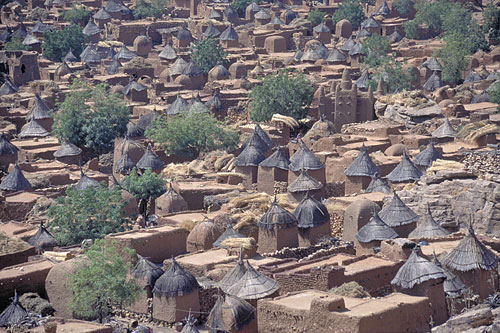
The Dogon are an ethnic group located mainly in the districts of Bandiagara and Douentza in Mali, West Africa. This area is composed of three distinct topographical regions: the plain, the cliffs, and the plateau. Within these regions the Dogon population of about 300,000 is most heavily concentrated along a 200-kilometer (125 mile) stretch of escarpment called the Cliffs of Bandiagara. These sandstone cliffs run from southwest to northeast, roughly parallel to the Niger River, and attain heights up to 600 meters (2000 feet). The cliffs provide a spectacular physical setting for Dogon villages built on the sides of the escarpment. There are approximately 700 Dogon villages, most with fewer than 500 inhabitants.

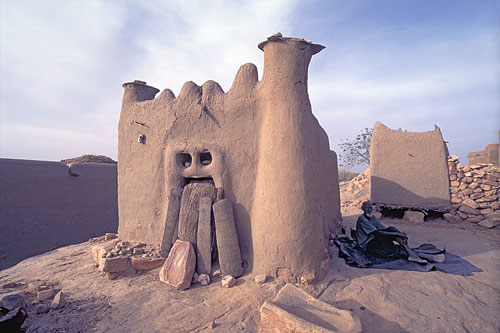
Binu shrine, Bandiagara escarpment, Mali 

 The precise origins of the Dogon, like those of  many other ancient cultures, are lost in mists of  time. The early histories are informed by oral  traditions (that differ according to thethe Dogon  clan being consulted) and archaeological  excavation (much more of which needs to be  conducted).

 Because of these inexact and incomplete  sources, there are a number of different  versions of the Dogon’s origin myths, as well as  differing accounts of how they got from their  ancestral homelands to the Bandiagara region.

The people call themselves Dogon or Dogom, but in the older literature they are most often called Habe, a Fulbe word meaning ‘stranger’ or ‘pagan.’ Certain theories suggest the tribe to be of ancient Egyptian descent. After living in the region of Libya, they are believed to have migrated to somewhere in the region of Burkina Faso, Guinea or Mauritania (different scholarly sources give different places for this period). Around 1490 AD, fleeing invaders and/or drought, they migrated to the Bandiagara cliffs of central Mali. Carbon-14 dating techniques used on excavated remains found in the cliffs indicate that there were inhabitants in the region before the arrival of the Dogon; these were the Toloy culture of the 3rd to 2nd centuries BC, and the Tellem culture of the 11th to 15th centuries AD.

Dogon village of Songo, with mud mosque, Mali
The earliest study of the Dogon was undertaken in 1903 by Louis Desplagnes, a lieutenant in the French colonial army. The first scientists to visit and study the Dogon people were the French anthropologists Marcel Griaule and Germaine Dieterlen, who initially made contact with the Dogon in 1931 and continued to intensively research them for the next three decades. Griaule and Dieterlen conducted detailed investigations of the complex Dogon rituals and symbolism, and the cosmological ideas of which they are an expression. Griaule’s two most important works are Masques Dogons (1938) and Dien d’Eau (1948). The latter work was published in English in 1965 under the title Conversations with Ogotemmeli: An Introduction to Dogon Religious Ideas.

The religious beliefs of the Dogon are complex and knowledge of them varies within Dogon society. Dogon religion is defined primarily through the worship of the ancestors and the spirits that they encountered as they slowly migrated from their obscure ancestral homelands to the Bandiagara cliffs. There are three principal cults among the Dogon; the Awa, Lebe and Binu. The Awa is a cult of the dead, whose purpose is to reorder the spiritual forces disturbed by the death of Nommo, a mythological ancestor of great importance to the Dogon. Members of the Awa cult dance with ornate carved and painted masks during both funeral and death anniversary ceremonies. There are 78 different types of ritual masks among the Dogon and their iconographic messages go beyond the aesthetic, into the realm of religion and philosophy. The primary purpose of Awa dance ceremonies is to lead souls of the deceased to their final resting place in the family altars and to consecrate their passage to the ranks of the ancestors.

The cult of Lebe, the Earth God, is primarily concerned with the agricultural cycle and its chief priest is called a Hogon. All Dogon villages have a Lebe shrine whose altars have bits of earth incorporated into them to encourage the continued fertility of the land. . According to Dogon beliefs, the god Lebe visits the hogons every night in the form of a serpent and licks their skins in order to purify them and infuse them with life force. The hogons are responsible for guarding the purity of the soil and therefore officiate at many agricultural ceremonies.

The cult of Binu is a totemic practice and it has complex associations with the Dogon’s sacred places used for ancestor worship, spirit communication and agricultural sacrifices. Marcel Griaule and his colleagues came to believe that all the major Dogon sacred sites were related to episodes in the Dogon myth of the creation of the world, in particular to a deity named Nommo. Nommo was the first living being created by Amma (the sky god and creator of the universe) and he soon multiplied to become four sets of twins. One of the twins rebelled against the order established by Amma, thereby destabilizing the universe. In order to purify the cosmos and restore its order, Amma sacrificed another of the Nommo, whose body was cut up and scattered throughout the universe. This distribution of the parts of the Nommo’s body is seen as the source for the proliferation of Binu shrines throughout the Dogon region.

In addition to containing parts of Nommo’s body, Binu shrines house spirits of mythic ancestors who lived in the legendary era before the appearance of death among mankind. Binu spirits often make themselves known to their descendants in the form of an animal that interceded on behalf of the clan during its founding or migration, thus becoming the clan’s totem. The priests of each Binu maintain the sanctuaries, whose facades are often painted with graphic signs and mystic symbols. Sacrifices of blood and millet porridge (millet being the primary crop of the Dogon) are made at the Binu shrines at planting time and whenever the intercession of the immortal ancestor is desired. Through such rituals, the Dogon believe that the benevolent force of the ancestor is transmitted to them.
Binu shrine near Arou-by-Ibi, Bandiagara, Mali
In the late 1940’s, Dogon priests greatly surprised the French anthropologists Griaule and Dieterlen by telling them secret Dogon myths about the star Sirius (8.6 light years from the earth). The priests said that Sirius had a companion star that was invisible to the human eye. They also stated that the star moved in a 50-year elliptical orbit around Sirius, that it was small and incredibly heavy, and that it rotated on its axis.

All these things happen to be true (the actual orbital figure is 50.04 +/- 0.09 years). But what makes this so remarkable is that the companion star of Sirius, called Sirius B, was first photographed in 1970. While people began to suspect its existence around 1844, it was not seen through a telescope until 1862. The Dogon beliefs, on the other hand, were supposedly thousands of years old. The Dogon name for Sirius B (Po Tolo) consists of the word for star (tolo) and "po," the name of the smallest seed known to them. By this name they describe the star's smallness -- it is, they say, "the smallest thing there is." They also claim that it is "the heaviest star," and white. The tribe claims that Po is composed of a mysterious, super-dense metal called sagala, which they declare is heavier than all the iron on Earth. Not until 1926 did Western science discover that this tiny star is a white dwarf, a category of star characterized by very great density.

Many artifacts were found describing the star system, including a statue examined by Dieterlen that is at least 400 years old. The Dogon also describe a third star in the Sirius system, called Emme Ya. Larger and lighter than Sirius B, this star revolves around Sirius as well. Around the star Emme Ya orbits a planet from which the mythic Nommos originally came. To date, however, astronomers have not identified Emme Ya. Will our celestial observation devices one day be powerful enough for us to find this legendary planet, thereby adding still more mystery to the extraordinary - seemingly impossible - astronomical knowledge of the Dogon?

In addition to their knowledge of the Sirius group, the Dogon mythology includes Saturn's rings and Jupiter's four major moons. They have four calendars, for the Sun, Moon, Sirius, and Venus, and have long known that planets orbit the sun. The Dogon say their astronomical knowledge was given to them by the Nommos, amphibious beings sent to Earth from Sirius for the benefit of mankind. The word Nommos comes from a Dogon word meaning, "to make one drink," and the Nommos are also called Masters of the Water, the Monitors, and the Teachers.

The Nommos were more fishlike than human
The Dogon myths tell the legend of the Nommos, who arrived in a vessel along with fire and thunder. After they arrived here - they put out a reservoir of water onto the Earth then dove into the water. There are references in the oral traditions, drawings and tablets of the Dogons, to human-looking beings who have feet but who are portrayed as having a large fish skin running down their bodies. The Nommos were more fishlike than human and had to live in water. They were saviors and spiritual guardians: "The Nommo divided his body among men to feed them; that is why it is also said that as the universe "had drunk of his body," the Nommo also made men drink. He gave all his life principles to human beings." The Nommo was crucified and resurrected and in the future will again visit the Earth, this time in human form. Similar creatures have been noted in other ancient civilizations -- Babylonia's Oannes, Acadia's Ea, Sumer's Enki, and Egypt's goddess Isis.

The photographs show Binu shrines near Sangha and Arou-by-Ibi (the ostrich eggs atop the roof spires symbolize fertility and purity). Readers wishing to study the Dogon in more detail are encouraged to consult the writings of Marcel Griaule, Pascal Imperato, Robert Temple, and Shannon Dorey listed in the bibliography. Portions of the foregoing information were taken from these authors.
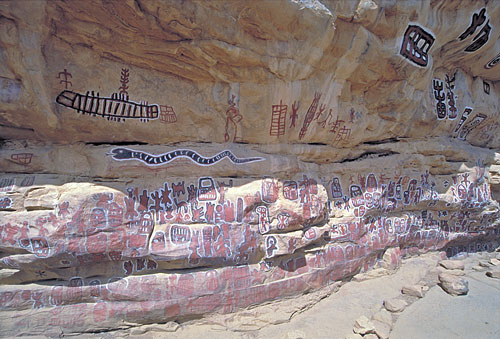
Rite of passaage ceremonial site
Rite of passaage ceremonial site for Dogon boys becoming men, 
near village of Songo, Bandiagara
Contributions with thanks from:
Places Of Peace And Power


Sunday, August 12, 2012

The Dogon Tribe of West Africa and the alien connection


The Dogon tribe can be found in a region in Mali south of the Sahara Desert. French anthropologists Drs Marcel Griaule and Germaine Dieterlen studied the tribe from 1931 to 1956. Dogon mythology is only known by a hand full of their priests. This is a very hard to understand system, not easily given to even the friendliest of strangers. 
The culture of the Dogon tribe in West Africa centers around a star in our gallery. Sirius A is a big, bright star, has two and a half times the mass of our sun. Sirius, or actually its companion star, Sirius B. Sirius B has ninety-five per cent of the mass of our sun The Sirius Star is in the Canis Major Constellation. Sirius is visible with the naked eye, its companion is not. Now what is really fascinating about this is how these people knew about this, after all they have no telescopes. Sirius B wasn’t even visible with telescopes until 1862, or photographed until 1970. Dogon astronomical lore is dated back to 3200 B.C.
According to the Dogon legend the tribe was visited by a race of people called the Nommos, which come from the Sirius system. The Nommos resembled ugly amphibious beings. It is believed that the Nommos gave the Dogon tribe knowledge about their solar system. For instance: Jupiter has four major moons, Saturn has rings, and the plants revolve around the sun, and not vice versa. These facts weren’t known until Galileo invented the telescope. 
After they landed, the Nommos released a body of water which they later inhabited. They could live on land, but preferred the sea. Oral stories, drawing and tablets, depict the Nommo with large fish skin running down their bodies. The Nommos were regarded as saviors and spiritual guardians.
Carl Sagan believes that our modern knowledge of the Dogon tribe came from westerners or Europeans, who discussed astronomy with the tribes’ priests. Sagan believes that if Europeans came to the Dogon tribe, they most likely would have discussed “astronomical matters”, and talked about the brightest star in the sky. This however doesn’t explain a 400 year old artifact that shows the Sirius configuration. It also doesn’t explain how the Dogon tribe knows how dense Sirius B is.
They also tell us that Sirius B has a 50-year elliptical orbit around Sirius.
The Dogons refer to Sirius B as Po Tolo. “Tolo”, means small, and po means star. The tribe claims that Po is composed of a material known as sagala, a mineral heavier then all of Earth’s iron.
While many parts of the legend are considered true ,there are some parts in question. For example, the Dogons’ believe that Sirius B once occupied the spot where our sun is now. Physics disprove this. Also, if the Dogon believe that Sirius A orbits Sirius B every 50 years, then why do they have their celebrations every 60 year? The Dogons believe there is a third star called "Emme Ya" . So far this is yet to be discovered. According to legend, the Nommo breath through holes in their collarbone.
The Dogon are not the only people that have a strong connection with Sirius, Sumer, Babylonia's Oannes, Acadia's Ea, Sumer's Enki, and Egypt's goddess Isis. The Egyptian goddess Isis which is said to be mermaid –like. The ancient Egyptians also believed Sirius was significant . Their calendar was based on the rising of Sirius. Even thou there is no solid evidence of a third star, in 1995 French researchers, Daniel Benest and J.L. Duvent, published an article which states that it is possible that Sirius is a triple star.