Showing posts with label west africa. Show all posts

Saturday, February 11, 2017

Head of a Queen Mother (Iyoba)

Head of a Queen Mother (Iyoba)
1750–1800 - Nigeria, Court of Benin
Courtesy: The MET Museum of Art
In the Benin kingdom, the iyoba, or mother of the oba (king), occupies an important and historically significant place within Benin's political hierarchy. The title was first conferred upon Idia, the mother of king Esigie, who used her political skill and supernatural abilities to save her son's kingdom from dissolution in the late fifteenth century. Ever since that time, queen mothers have been considered powerful protectors of their sons and, by extension, the kingdom itself. Because of the enormous esteem in which they are held, iyobas enjoy privileges second only to the oba himself, such as a separate palace, a retinue of female attendants, and the right to commission cast brass sculptures for religious or personal use.

Ancestral altars dedicated to past iyobas, like those of past kings, are furnished with cast brass commemorative heads. The heads of queen mothers are distinguished from those of kings by the forward-pointing peaks of their coral-beaded crowns. Commemorative heads of iyobas hold to the same stylistic chronology as those of obas. Earlier heads were cast with thinner walls and display tight beaded collars that fit snugly beneath the chin. Later versions have thicker walls, exhibit enlarged cylindrical collars that cover the face up to the lower lip, and are designed with a circular opening behind the peak of the crown to hold a carved ivory tusk. This head of an iyoba dates from the eighteenth century. While its high collar and pierced crown place it with later examples, the sensitive, naturalistic modeling of the face is reminiscent of the earliest commemorative heads.

Article: Courtesy of: The Metropolitan Museum of Art
Image: Courtesy of: The Metropolitan Museum of Art
Date: 1750–1800
Geography: Nigeria, Court of Benin
Culture: Edo peoples
Medium: Brass
Dimensions: H. 16 3/4 x Diam. 11 3/4 in. (42.5 x 29.9 cm)
Classification: Metal-Sculpture
Credit Line: Bequest of Alice K. Bache, 1977
Accession Number: 1977.187.36

Benin bronze heads are easily sold for $12,000 upwards on eBay... What's In Your Attic?


Thursday, January 26, 2017

The Dogon of Mali Way Of Life

A Dogon Mask
Courtesy of: http://www.hamillgallery.com
Dogon statues are conserved in the semi darkness of sanctuaries or of family homes. These objects are made to be touched rather than seen. Occasionally offerings and sacrifices are made to them. The statues are made by a blacksmith, who, if he has talent can create true works of art. The masks are sculpted by non specialists during the course of a ritual that takes place outside of the village.

Dogon style has evolved towards a type of cubism with ovoid heads, square shoulders, slender limbs, pointed breasts, forearm and thighs in the same parallel plane, and a coiffure stylized by two or three incisions. Dogon statues express in particular religious values and feelings. They act as a support to initiation rituals and in explaining the world.

The Dogon live in the south of Mali, a region which is made up of plains, a plateau and above all an escarpment. The Bandiagara escarpment is 260 km long and overhangs the plains. The Dogon cultivate millet, sorgho, fonio, rice and durum wheat at the edge of the cliffs and near the rare water points. They are not the first inhabitants of this region. The Dogon say that they came from Mande, or the Ancient Mali Empire to escape from Islamization. They probably started their migration between the 10th and 13th centuries and chased the Tellum from the cliffs. The memory of the Tellum is conserved in grain stores at the foot of the cliffs and rocky cavities where their dead were buried along with the statues.

Dogon Religion

Before the world was created, there was a God called Amma who had the appearance of an egg. Amma created four male and four female creatures. The males are: Nommo Die, Nommo Titiyayne, O Nommo and Ogo and were created in the form of fish. But Ogo rebelled before he was fully finished, as he wanted to make the creation his own. O Nommo was sacrificed to pay back the error of his twin Ogo and came down to earth in the ark that carried men’s ancestors and all living beings. Ogo, rebelling against Amma, detached himself from Amma’s placenta, ripping part of it away, and came down to earth with the ark.

In leaving Amma’s womb prematurely, he did not wait for the full gestation of his twin. He found himself weak and alone because Amma had transformed the piece of placenta torn out by Ogo, into our earth and the moon. Ogo, displeased with the earth, unfit for cultivation, went back up to the sky to interrupt Amma’s work and to retrieve the remains of his placenta. But Amma, wanting to put this piece of placenta out of Ogo’s reach, transformed it into our sun. Next, Amma transformed Ogo into a four legged creature, a pale fox that from that moment on would be the instrument of chaos in the universe. In accepting the opposition of the fox, and the chaos that he brought to the universe, Amma allowed psychological dualism and individualization to be created. In order to reorganize the universe that had been disturbed by the fox, Amma decided to sacrifice her twin brother O Nommo. His blood served to purify the earth and his body, cut into pieces, allowed the stars, the animals and the plants to appear. After this purification of the universe, O Nommo was brought back to life and sent back to earth by Amma, to give birth to humans and to reorganize life on earth. Amma had made men immortal, but following the chaos brought by the fox to the earth, death appeared. The ark in which Ogo had come down to earth became uncultivated land, and that of O Nommo the symbol for cultivated land. After all the beings had descended from the ark, O Nommo (or Nommo) returned to  his fish like form and went to live in the great expanse of water (the oceans) that had been born of the first rainfall. It is in the water that Nommo reveals to man the words woven through his teeth.

The Dogon religion is made up of the belief in Amma, distant and immaterial God, but which is realized through institutions and ongoing actions towards the ancestors:

1° The cult of the immortal totemic ancestors.

2° The Lebe cult, a great ancestor who died and was brought back to life in the form of a snake. Lebe is the great ancestor whose sons gave birth to the four tribes: Dyon, Dommo, Ono and Arou.

3° The mask cult, mortal ancestors.

The Dogon Economy

The Dogon are farming people, with a system of patrilineal descent and patrilocal residency. There is a division of labour. The men cultivate the fields and hunt albeit for a meager result (because of the lack of game) weave and make basket work. The women take care of the home, make pottery, spin cotton and dye fabric. The blacksmith doesn’t only work metal he also makes objects out of wood. He is an important person and belongs to a caste.

Social Organisation among the Dogon and Initiation rites

Comprising several totemic clans, the Dogon village comes under the authority of the council of elders. The clans are subdivided into lineages, led by the patriarch, the guardian of the ancestral altar and responsible for the cult.

There are other broader communities than the clan, these are the four initial tribes (Dyon, Arou, Ono, Dommo) each the respective descendant of the four mythical ancestors (Amma Serou, Libe Serou, Binou Serou, Dyongou Serou). In the beginning, they should have shared the Dogon country between them, but they were finally integrated into the same territory. It is at the heart of these tribal proceedings that the ‘Hogons’, or highest religious dignitaries and heads of a region, are named. They are in charge of the cult of the mythical snake Lebe and the cult of the ancestor Lebe Serou. Aided by the blacksmith, they preside over agrarian ceremonies. Masters of exchange and commerce they do not work the land and cannot leave their house, considered as a sanctuary. The supreme Hogon is the one that resides at Arou.

In correlation to this hierarchical relationship there is also a system of grouping by age, whereby the members mutually owe each other lifelong help and assistance.

Circumcision and excision open the door to adulthood and allows young people to marry and participate in social and ritualistic life.

Masculine and feminine associations are responsible for the initiation which is carried out by age group. Members of each age group owe mutual and lifelong help to the other members of the group. A boy’s initiation begins after his circumcision. This begins with teachings of traditional myths, taught through the medium of drawings and paintings. The boys learn man’s place in nature, society and the universe. Dogon mythology is so complicated that a griot would need a week to tell it in its entirety.

Blacksmiths and wood carvers form a separate caste. Their trade is mainly passed down from generation to generation. They are feared and respected by the community who attribute particular powers to them. They can only marry inside their own caste. The women take care of the pottery.

Great Dogon Ceremonies

The masculine association or ‘Awa’ is responsible for initiation and equally organizes the great ceremonies that take place at the end of the mourning period. This period can last for several days and recalls the memories of people that have died within the last two or three years. Two main types of mask are made for these occasions:

The ‘Sirige,’ or house with several storeys, is worn by a dancer who mimics the myth of creation and the descent from the ark. The Kanaga mask is crowned by a cross indicating the skies and the earth. They are accompanied by other types of zoomorphic masks: antelope, hyena, lion, hare, monkey, buffalo, bird, as well as other helm masks embellished with horns and a muzzle. These masks might be decorated in red, black or white.

The grand Sigui ceremony takes place every 60 years. It is symbolized by a snake mask, and everyone in the community takes part in the event.

Dogon Sculpture

Dogon sculpture is conserved in the semi darkness of sanctuaries or of family homes. These objects are
made to be touched rather than seen. Occasionally, offerings and sacrifices are made to them.

The masks are sculpted by non specialists during the course of a ritual that takes place outside of the village. The statues are made by a blacksmith who, if he has talent, can create true works of art in his house situated in a quarter reserved especially for professionals who work under the watchful eye of the population. The quality of the work also depends on the wealth of the person who commissions it.

In this region of Mali, it is important to recognize the works of art that were made by the Tellum, the predecessors of the Dogon, who occupied the area in the 11th and 12th centuries.

The main theme of the statues is the sacrifice of Nommo. The statues are created from a wood that is thought to be hard and powerful.  They follow the relationship of Nommo and Amma at various periods of their lives.

The signification of the different representations is mainly as follows:

If the statue has one arm raised up it symbolizes the relationship between O Nommo and Amma before his sacrifice, but also of his role as the organizer of the world. Sometimes, he is hermaphrodite because Nommo is bisexual. When both arms are raised but separated, Nommo is praying to Amma to allow him to stay with her after his resurrection. If both arms are raised and joined together, Nommo is praying for Amma to come to him and protect him. When both arms are raised with the hands together and the palms facing up to the sky, Nommo is imploring the rain to fall. When both arms are down by the sides this position symbolizes Nommo’s descent to earth. With both arms spread out away from the body and with the palms facing forward, Nommo reveals his role of guardian of space. If Nommo has both hands placed on his thighs this means that he is relying on Amma.

Throughout these different representations, the face is often very smooth signifying that the world must remain clean and organized like a smoothly shaved face.
A couple of primordial ancestors.
Courtesy of http://www.hamillgallery.com

The figure of a man’s statue incorporates traits that are the essence of Dogon sculpture. They translate the monumentality that is obtained through a strict use of volume, reducing the physiognomy down to the essential (without superfluous detail), disturbing the serious face of the character with its long and extremely triangular nose.

A couple of primordial ancestors, sitting side by side share the same characteristics. The faces are harsh and the rigidity of the pair is only broken by the gesture of tenderness of the man putting his arm around his companion’s shoulder.

Again, the same characteristics apply for a statue of a woman sitting on a stool decorated with sculptures of the ancestors. The coiffure of the seated woman is more heavily refined, but the principal traits of the face are schematic: diamond shaped eyes, rectilinear nose in the form of an arrow, slit mouth. Sculptures of women with children are treated in the same austere and monumental manner. A woman crushing seeds is sculpted in the same synthetic manner, without any anecdotal features.

Xylophone or balafon players are treated in the same hieratic way, full of nobility and severity.

A great number of figures recall that Nommo pulled the ark towards a hollow filled with water by changing himself into a horse.

  • The Dogon create hermaphrodite, ‘Tellum type’ statues where the arms are raised and which are covered with a thick patina of blood and millet beer.
  • The four Nommo couples, mythical ancestors born of the God Amma, decorate stools, the columns of the men’s meeting houses, as well as locks and barn doors.
  • The primordial couple is represented sitting on a stool, of which the base represents the earth and the top tray the sky. Between the base and the tray Nommo is figured, the ancestor of all humans.
  • The feminine seated figures, with their hands on their stomachs, are linked to the fecundity cult and are the incarnation of the first dead ancestor that died in childbirth. They are the object of offerings and sacrifices made by pregnant women.
  • The kneeling statues of the protecting ancestors are placed next to the deceased’s head in order to absorb his spiritual force. They play an intermediary role with the afterlife by accompanying the deceased. They are then returned to the ancestral altars.

Dogon style has evolved towards a type of cubism with ovoid heads, square shoulders, slender limbs, pointed breasts, forearm and thighs in the same parallel plane, a coiffure stylized by two or three incisions. Dogon statues express in particular religious values and feelings. They act as a support to initiation and as an explanation of the world itself. Hidden in sanctuaries or in the Hogan’s dwelling, they act as vectors of knowledge for the initiate who will learn how to interpret the signs of the statue depending on his level of knowledge.

Dogon art also manifests itself in architecture, and both cult and domestic objects.

Dogon blacksmiths also make ritual irons showing Nommo in various stances and situations as for the statues, but along with some fish like elements.

Article courtesy of African-Art.net
Images courtesy of HamillGallery.com  

Monday, January 23, 2017

History of the Marka Masks of Mali, West Africa

Courtesy of Fondazione Passaré
Marks Masks of Mali
The masks of the Marka (a Mande subgroup) originated in the landlocked country of Mali, West Africa. Long ago masks such as the Marka were thought to be extremely powerful and had the ability to frighten away evil spirits, convey messages from the spirit world and cure illnesses. The Marka would perform ceremonies devoted to fishing and farming, and their stylized masks would be danced to invoke the spirits to grant the community with abundant agricultural yields and a successful fishing season.

The masks of the Marka are narrow and austere, with a sharp chin. They are brightly painted or coated with metal along with raised ornamentation, achieving a fine decorative effect that is very distinctive and different from most other African mask styles. The men of the Marka, clad in costumes of colorful cloth, always appear in pairs to represent man's wooing of woman. The most characteristic deviation from the Bambara style is the cover of metal sheeting worked in conjunction with three metal bars attached to the forehead and red cotton at the end of each. The Marka society used this mask in two rituals, at the circumcision ceremony of adolescents, and when circumcised men advance from one grade to another. Along the Niger River the Marka used the masks in ceremonies related to fishing and farming.

This ethnic group is independent from the Bambara tribe but their styles show a strong Bambara influence. They live in the region that extends from the north of the Bambara to the Senegalese border. They live principally from agriculture with some subsidiary cattle rearing in the northern part of their territory. The dry savanna permits no more than a subsistence economy, and the soil produces, with some difficulty, millet, rice, and beans.

Courtesy of Fondazione Passaré
Marks Masks of Mali
Fertility played an important role in African Agricultural ceremonies. They were based on the idea that through the correct rituals, man could raise up the vital forces dwelling in a mask by gaining the blessing of his ancestor in order to help fertility and therefore achieve protection and primary security. The Agricultural Festivities the Africans celebrated were performed at different stages of the crop cycle. This crop cycle started with clearing of the land, then the planting, the reaping of the fruits, the harvest and finally the filling of the food stores. The concept of these festivals was the sacredness of the soil, which belonged to the ancestors, or the "masters of the soil". A successful harvest therefore depended on the thanksgiving of the ancestors or sometimes upon the good will of the goddess of the earth. African Masks

To see beautiful and affordable African Home Decor crafted by talented local African artisans, click on the following link: African Home Decor
Article Source: http://EzineArticles.com/expert/Mike_Griffis/268004

A Senufo sculpture was recently sold for $4,100 on eBay... 
What's In Your Attic?


Friday, September 11, 2015

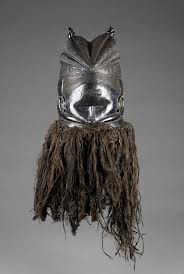
The Mende Helmet Mask "Bundu" or "Sowei" Mask of the Sande Society

In sub-Saharan Africa only men are normally permitted on ritual occasions to wear wooden masks. This black helmet mask is worn exclusively by women. The practice of women wearing masks seems to have been brought to several populations of  Sierra Leone and Liberia, such as the Temne, Gola and Vai, by the Mende and Mande-speaking people from the northern savanna. Because of the similarity of mask styles and the itinerant pathways of noted carvers, it is difficult to assign some masks to a particular ethnic group.

In the 19th century the Mende were organized into independent chiefdoms; families and individuals were ranked according to their land-use rights. Industrious rice farmers, the Mende number approximately two million people. The rituals of their women's society, called Sande, require the appearance of masked figures. Within such a large population there are many variations in local practices and carving styles, but there is broad agreement on the nature of the mask itself.

The mask presents an ideal of feminine beauty admired by the Mende: elaborate hairstyle, full forehead and small facial features.The gleaming surface signifies healthy, glowing skin. The swelling fleshy rolls alternating with deep incised lines at the neck or back of the head are considered marks of beauty and a promise of fecundity. The neck is broad to fit over the head of the woman who will wear it. Sande officials commission male carvers to produce the mask in secret. The surface is smoothed with the rough leaves of the ficus tree, then dyed black with a concoction made of leaves. Before use, it is anointed with palm oil to make it shine. (Modern carvers use black shoe polish.)

With this confining mask, the wearer (who has to be a good dancer and an official of the Sande) puts on a
thick cotton costume covered with heavy fibre strands dyed black. Her dances may last for over two hours. The sacredness of the mask lies in its deeper meaning as a representation of the long deceased founder of Sande society. In pre-colonial times women could hold the position of chief of a village cluster; until the 1970s women politicians continued to use the Sande society to support and further their careers in modern government. With increasingly rigorous Islamisation, however, the Sande society is being seriously modified or even disbanded.

"The costume worn with the black mask is made of layers of raffia fibers that have also been dyed black. These are attached to the lower portion of the neck as well as to a black cloth shirt or gown worn over the body. The sleeves are sewn shut, and long stockings or men's shoes are worn. No part of the body is left exposed, for revealing the body would expose the human agency behind the mask to the eyes of nonmembers, and would also allow the spirit to enter the human dancer rather than the mask.

Masked dancing provides a festive mood appropriate to the completion of the several stages of initiation. Masks are seen in public at several key moments during the process. Their appearances serve to announce to families of initiates that certain stages have been successfully accomplished and that preparation of foods and gifts of money must be completed. A mask may collect food from the community to take back to where initiation is taking place. She comes into the community to announce the imminent coming out of the girls, and she leads them into town on their first visit after the process has started. Finally, she leads the richly dressed girls into town when they have completed their training and are released. This is the high point of the entire process, for the girls are now recognized as marriageable, adult women.


The mask may appear at other times to bring justice to offenders of Sande law, to perform in respect at the funeral of an important leader of the society, and to participate in ceremonies in which a new mask is initiated into the work of Sande. Nowö is accepted as a living presence. The spirit speaks not through words but through the language of dance, referring to moral and social doctrines of beauty, serenity, dignity, control, order, and balance. Dance movements exaggerate the powers of ordinary women and dramatize the ideals of feminine beauty."

Excerpt above from: Poynor, Robin. 1995. African Art at the Harn Museum: Spirit Eyes, Human Hands. pp. 185-191. Article from the Rand African Art website - Denver, Colorado


Monday, August 25, 2014

CĂ´te d'Ivoire/Liberia; Dan peoples

Wakemia (ladle)

H. 64.8 x W. 17.8 x D. 11.4 cm

The Dan carve large spoons called wakemiaor wunkirmian, "spoon associated with feasts," that are carried by the most hospitable woman (wakede, called wunkirle in other reports) in a village neighborhood. 

"Awakede must be successful and industrious, and well accomplished in farming. She is the woman in her household who is responsible for the administration of food resources for the entire extended family. She must be of a generous and liberal disposition, a woman who gladly offers her hospitality to anyone at any time. She must provide food and lodging for guests; she must invite travelling musicians or other groups who are passing through the village to eat in her home... 

In order to be able to achieve all this, the wakede, not surprisingly, needs the help of a spirit which incarnates as her large spoon -- just as [Dan] mask spirits are incarnated in face masks. 

The spoon-spirits are believed to animate the wakemia to the extent that it may move itself without human assistance" (Fischer 1984:124). 

In many cases the handles of these spoons are carved to represent the owner of the spoon at the height of her physical beauty and fertility, and the bowl of the ladle takes the place of her belly,"pregnant with rice." 

The wakededances through the neighborhood giving out bowls of rice or small coins to those she meets. 

Professor Christopher D. Roy, School of Art and Art History, University of Iowa


Sunday, July 20, 2014

Sacred Sites of the Dogon, Mali

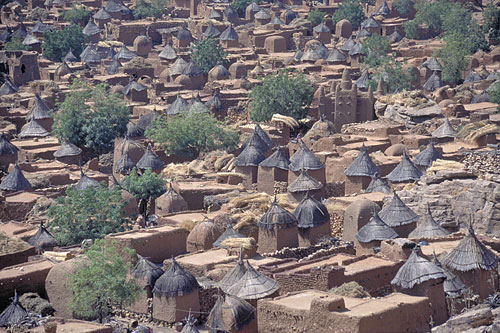
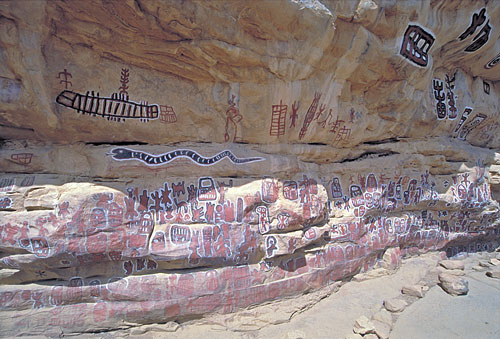
The Dogon are an ethnic group located mainly in the districts of Bandiagara and Douentza in Mali, West Africa. This area is composed of three distinct topographical regions: the plain, the cliffs, and the plateau. Within these regions the Dogon population of about 300,000 is most heavily concentrated along a 200-kilometer (125 mile) stretch of escarpment called the Cliffs of Bandiagara. These sandstone cliffs run from southwest to northeast, roughly parallel to the Niger River, and attain heights up to 600 meters (2000 feet). The cliffs provide a spectacular physical setting for Dogon villages built on the sides of the escarpment. There are approximately 700 Dogon villages, most with fewer than 500 inhabitants.

Binu shrine, Bandiagara escarpment, Mali 

 The precise origins of the Dogon, like those of  many other ancient cultures, are lost in mists of  time. The early histories are informed by oral  traditions (that differ according to thethe Dogon  clan being consulted) and archaeological  excavation (much more of which needs to be  conducted).

 Because of these inexact and incomplete  sources, there are a number of different  versions of the Dogon’s origin myths, as well as  differing accounts of how they got from their  ancestral homelands to the Bandiagara region.

The people call themselves Dogon or Dogom, but in the older literature they are most often called Habe, a Fulbe word meaning ‘stranger’ or ‘pagan.’ Certain theories suggest the tribe to be of ancient Egyptian descent. After living in the region of Libya, they are believed to have migrated to somewhere in the region of Burkina Faso, Guinea or Mauritania (different scholarly sources give different places for this period). Around 1490 AD, fleeing invaders and/or drought, they migrated to the Bandiagara cliffs of central Mali. Carbon-14 dating techniques used on excavated remains found in the cliffs indicate that there were inhabitants in the region before the arrival of the Dogon; these were the Toloy culture of the 3rd to 2nd centuries BC, and the Tellem culture of the 11th to 15th centuries AD.

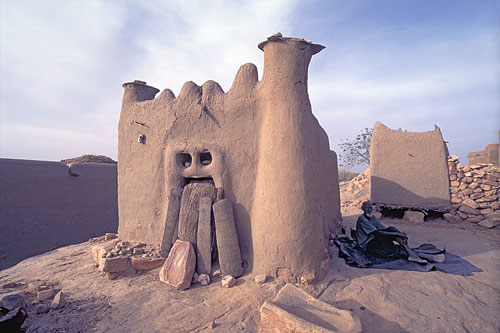
Dogon village of Songo, with mud mosque, Mali
The earliest study of the Dogon was undertaken in 1903 by Louis Desplagnes, a lieutenant in the French colonial army. The first scientists to visit and study the Dogon people were the French anthropologists Marcel Griaule and Germaine Dieterlen, who initially made contact with the Dogon in 1931 and continued to intensively research them for the next three decades. Griaule and Dieterlen conducted detailed investigations of the complex Dogon rituals and symbolism, and the cosmological ideas of which they are an expression. Griaule’s two most important works are Masques Dogons (1938) and Dien d’Eau (1948). The latter work was published in English in 1965 under the title Conversations with Ogotemmeli: An Introduction to Dogon Religious Ideas.

The religious beliefs of the Dogon are complex and knowledge of them varies within Dogon society. Dogon religion is defined primarily through the worship of the ancestors and the spirits that they encountered as they slowly migrated from their obscure ancestral homelands to the Bandiagara cliffs. There are three principal cults among the Dogon; the Awa, Lebe and Binu. The Awa is a cult of the dead, whose purpose is to reorder the spiritual forces disturbed by the death of Nommo, a mythological ancestor of great importance to the Dogon. Members of the Awa cult dance with ornate carved and painted masks during both funeral and death anniversary ceremonies. There are 78 different types of ritual masks among the Dogon and their iconographic messages go beyond the aesthetic, into the realm of religion and philosophy. The primary purpose of Awa dance ceremonies is to lead souls of the deceased to their final resting place in the family altars and to consecrate their passage to the ranks of the ancestors.

The cult of Lebe, the Earth God, is primarily concerned with the agricultural cycle and its chief priest is called a Hogon. All Dogon villages have a Lebe shrine whose altars have bits of earth incorporated into them to encourage the continued fertility of the land. . According to Dogon beliefs, the god Lebe visits the hogons every night in the form of a serpent and licks their skins in order to purify them and infuse them with life force. The hogons are responsible for guarding the purity of the soil and therefore officiate at many agricultural ceremonies.

The cult of Binu is a totemic practice and it has complex associations with the Dogon’s sacred places used for ancestor worship, spirit communication and agricultural sacrifices. Marcel Griaule and his colleagues came to believe that all the major Dogon sacred sites were related to episodes in the Dogon myth of the creation of the world, in particular to a deity named Nommo. Nommo was the first living being created by Amma (the sky god and creator of the universe) and he soon multiplied to become four sets of twins. One of the twins rebelled against the order established by Amma, thereby destabilizing the universe. In order to purify the cosmos and restore its order, Amma sacrificed another of the Nommo, whose body was cut up and scattered throughout the universe. This distribution of the parts of the Nommo’s body is seen as the source for the proliferation of Binu shrines throughout the Dogon region.

In addition to containing parts of Nommo’s body, Binu shrines house spirits of mythic ancestors who lived in the legendary era before the appearance of death among mankind. Binu spirits often make themselves known to their descendants in the form of an animal that interceded on behalf of the clan during its founding or migration, thus becoming the clan’s totem. The priests of each Binu maintain the sanctuaries, whose facades are often painted with graphic signs and mystic symbols. Sacrifices of blood and millet porridge (millet being the primary crop of the Dogon) are made at the Binu shrines at planting time and whenever the intercession of the immortal ancestor is desired. Through such rituals, the Dogon believe that the benevolent force of the ancestor is transmitted to them.
Binu shrine near Arou-by-Ibi, Bandiagara, Mali
In the late 1940’s, Dogon priests greatly surprised the French anthropologists Griaule and Dieterlen by telling them secret Dogon myths about the star Sirius (8.6 light years from the earth). The priests said that Sirius had a companion star that was invisible to the human eye. They also stated that the star moved in a 50-year elliptical orbit around Sirius, that it was small and incredibly heavy, and that it rotated on its axis.

All these things happen to be true (the actual orbital figure is 50.04 +/- 0.09 years). But what makes this so remarkable is that the companion star of Sirius, called Sirius B, was first photographed in 1970. While people began to suspect its existence around 1844, it was not seen through a telescope until 1862. The Dogon beliefs, on the other hand, were supposedly thousands of years old. The Dogon name for Sirius B (Po Tolo) consists of the word for star (tolo) and "po," the name of the smallest seed known to them. By this name they describe the star's smallness -- it is, they say, "the smallest thing there is." They also claim that it is "the heaviest star," and white. The tribe claims that Po is composed of a mysterious, super-dense metal called sagala, which they declare is heavier than all the iron on Earth. Not until 1926 did Western science discover that this tiny star is a white dwarf, a category of star characterized by very great density.

Many artifacts were found describing the star system, including a statue examined by Dieterlen that is at least 400 years old. The Dogon also describe a third star in the Sirius system, called Emme Ya. Larger and lighter than Sirius B, this star revolves around Sirius as well. Around the star Emme Ya orbits a planet from which the mythic Nommos originally came. To date, however, astronomers have not identified Emme Ya. Will our celestial observation devices one day be powerful enough for us to find this legendary planet, thereby adding still more mystery to the extraordinary - seemingly impossible - astronomical knowledge of the Dogon?

In addition to their knowledge of the Sirius group, the Dogon mythology includes Saturn's rings and Jupiter's four major moons. They have four calendars, for the Sun, Moon, Sirius, and Venus, and have long known that planets orbit the sun. The Dogon say their astronomical knowledge was given to them by the Nommos, amphibious beings sent to Earth from Sirius for the benefit of mankind. The word Nommos comes from a Dogon word meaning, "to make one drink," and the Nommos are also called Masters of the Water, the Monitors, and the Teachers.

The Nommos were more fishlike than human
The Dogon myths tell the legend of the Nommos, who arrived in a vessel along with fire and thunder. After they arrived here - they put out a reservoir of water onto the Earth then dove into the water. There are references in the oral traditions, drawings and tablets of the Dogons, to human-looking beings who have feet but who are portrayed as having a large fish skin running down their bodies. The Nommos were more fishlike than human and had to live in water. They were saviors and spiritual guardians: "The Nommo divided his body among men to feed them; that is why it is also said that as the universe "had drunk of his body," the Nommo also made men drink. He gave all his life principles to human beings." The Nommo was crucified and resurrected and in the future will again visit the Earth, this time in human form. Similar creatures have been noted in other ancient civilizations -- Babylonia's Oannes, Acadia's Ea, Sumer's Enki, and Egypt's goddess Isis.

The photographs show Binu shrines near Sangha and Arou-by-Ibi (the ostrich eggs atop the roof spires symbolize fertility and purity). Readers wishing to study the Dogon in more detail are encouraged to consult the writings of Marcel Griaule, Pascal Imperato, Robert Temple, and Shannon Dorey listed in the bibliography. Portions of the foregoing information were taken from these authors.
Rite of passaage ceremonial site
Rite of passaage ceremonial site for Dogon boys becoming men, 
near village of Songo, Bandiagara
Contributions with thanks from:
Places Of Peace And Power


Saturday, September 08, 2012

African Maternity Figures

Akan brass maternity figure on stool
In almost all African societies, the most important role of women is to bear children. Whatever else – farming, cooking, or their role in women’s associations – their primary responsibility is to produce and nurture children. 

It is, as Cole puts it, a “biological imperative” or, as Dennis Warren states, “cultural duty" (1974, 2.37). Indeed, certain groups, such as the !Kung, "do not consider a marriage consummated until the birth of a child" (Fried and Fried 1980, 29).

"A person who has no descendants in effect quenches the fire of life, and becomes forever dead since his line of physical continuation is blocked if he does not get married and bear children" (Mbiti 1969, 133).

Unhappy is the woman who fails to get children for, whatever other qualities she might possess, her failure to bear children is worse than community genocide: she has become the dead end of human life, not only for the genealogical line but also for herself. . . . the childless wife bears a scar which nothing can erase. She will suffer for this, her own relatives will suffer for this: and it will be an irreparable humiliation for which there is no source of comfort in traditional life.

In such a setting, it is not surprising to find great numbers of images of women with children in Africa. The earliest known are several terracottas from Nok in northern Nigeria possibly dating as early as the sixth century B.C. Bernard Fagg writes, "There are two or three pieces, and the frieze of figures . . . which may possibly be representing the concept of motherhood" (1977, 38). The frieze has "repetitive modelling of what is probably a 'mother and child' 
motif".

Images of women holding children may reflect a number of ideas, for example, they may represent ancestors and serve as "symbols of lineage or clan forbears, the generalized and incarnate dead" (Cole 1985, 8). It can only be conjectured that the Djenne example with its "mother" and adult "children" may be an instance of such a meaning.
Afo Maternity Figure (Nigeria 19th Century) wood
Afo Maternity Figure
(Nigeria 19th Century) wood

In most cases, the child or children are not identifiable; indeed, they are often amorphous or even caricatural in form. William Fagg refers to the "unwritten law on the portrayal of mothers and children in sculpture, a law so general that it must surely have a philosophical basis. This is the rule that children are not given a personality or character of their own, but are treated as extensions of their mother's personality" (in Vogel 1981, 1x4).

Others, such as Vogel, note: Because children are not fully "civilized" (or socialized), productive members of society, their depiction in art makes little sense. Infants, in contrast, often appear in a secondary role, representing the productivity of the mother. To cite a parallel from life, one often sees a woman dressed up and carrying a child (not necessarily her own) as a sort of costume accessory. A woman looks better with a baby. (1980, 13)

Thus we come at once to a major contrast between African maternity images and Christian images of Mary and the Christ child. In the latter, the primary focus is on the infant, and the mother is definitely a secondary figure. This is clearly the reverse of the roles of child and mother in African examples. The child, as a symbol of maternity, supports and reinforces the role of the mother as genetrix for the family and the group.

Examples are known where the mother is standing , kneeling, or sitting; the child may be suckling or may be held on the lap or carried on the back, and there may be more than one child. In contrast, scenes of birth are rare, and the rituals surrounding birth rarely make use of sculpture.


Akan Maternity Figure - Ghana -Mid-late 20th century
Akan Maternity Figure - Ghana
Mid-late 20th century
Henry Drewal (1978, 564) has pointed out that among the arts of the Yoruba, "Mothers shown nursing or carrying children represent the long weaning period (approximately two years), a time of sexual abstinence and suppressed menstruation . . . which is seen as a state of purity or ritual cleanliness." 

Elsewhere he states, "Pregnant and nursing women achieve a state related to that of elder women," who are past menopause and therefore free of the pollution of menses. Thus mother and child images denote a state of natural purity; for during the long nursing period . . . when the child is carried on the back, a woman's menstruation is suppressed and she practices sexual abstinence. . . . Thus images of women in ritual contexts and mother and child figures represent much more than symbols of fertility. They communicate sexual abstinence, inner cleanliness, ritual purity, female forces and spirituality.

Some Yoruba figures are shown kneeling, "a position of respect, devotion, and even submission to the gods. This posture is appropriate [because] most women in Yoruba sculptures represent royal wives or worshipers, not gods themselves" (Cole 1985, 19).

It is evident that although the specific meaning of images of maternity may vary from group to group and be associated with nature deities, ancestors, the group genetrix, or divination, they all ultimately and surely refer to human fertility and the future of the group that is grounded in that fertility.

There are images that are specifically approached when a woman wants to conceive. Such images are found on Yoruba doors or as shrine images in Ghana in the town of Anyinabrem where the sculpture of a mother suckling a baby was visible and, "when barren patients come to the shrine and see this statue they know the god can help them to get a child" (Warren 1974, 386).

Much more common in southern Ghana among several groups are akua'ba images, which are believed to relate directly to human fertility. These may be used by a priestess, as Warren reports (ibid., 388), to help barren women have children, or they may be carried by a woman after she conceives to ensure that she will have a healthy and handsome child. Others, quite similar in form, may help a woman "keep" a child that has been born several times but has not lived. It is believed that the intervention of the fertility deity will ensure a successful birth.

Roy Seiber
From: African Art in the Cycle of Life
Article from the Rand African Art website - Denver, Colorado


Sunday, August 12, 2012

The Dogon Tribe of West Africa and the alien connection


The Dogon tribe can be found in a region in Mali south of the Sahara Desert. French anthropologists Drs Marcel Griaule and Germaine Dieterlen studied the tribe from 1931 to 1956. Dogon mythology is only known by a hand full of their priests. This is a very hard to understand system, not easily given to even the friendliest of strangers. 
The culture of the Dogon tribe in West Africa centers around a star in our gallery. Sirius A is a big, bright star, has two and a half times the mass of our sun. Sirius, or actually its companion star, Sirius B. Sirius B has ninety-five per cent of the mass of our sun The Sirius Star is in the Canis Major Constellation. Sirius is visible with the naked eye, its companion is not. Now what is really fascinating about this is how these people knew about this, after all they have no telescopes. Sirius B wasn’t even visible with telescopes until 1862, or photographed until 1970. Dogon astronomical lore is dated back to 3200 B.C.
According to the Dogon legend the tribe was visited by a race of people called the Nommos, which come from the Sirius system. The Nommos resembled ugly amphibious beings. It is believed that the Nommos gave the Dogon tribe knowledge about their solar system. For instance: Jupiter has four major moons, Saturn has rings, and the plants revolve around the sun, and not vice versa. These facts weren’t known until Galileo invented the telescope. 
After they landed, the Nommos released a body of water which they later inhabited. They could live on land, but preferred the sea. Oral stories, drawing and tablets, depict the Nommo with large fish skin running down their bodies. The Nommos were regarded as saviors and spiritual guardians.
Carl Sagan believes that our modern knowledge of the Dogon tribe came from westerners or Europeans, who discussed astronomy with the tribes’ priests. Sagan believes that if Europeans came to the Dogon tribe, they most likely would have discussed “astronomical matters”, and talked about the brightest star in the sky. This however doesn’t explain a 400 year old artifact that shows the Sirius configuration. It also doesn’t explain how the Dogon tribe knows how dense Sirius B is.
They also tell us that Sirius B has a 50-year elliptical orbit around Sirius.
The Dogons refer to Sirius B as Po Tolo. “Tolo”, means small, and po means star. The tribe claims that Po is composed of a material known as sagala, a mineral heavier then all of Earth’s iron.
While many parts of the legend are considered true ,there are some parts in question. For example, the Dogons’ believe that Sirius B once occupied the spot where our sun is now. Physics disprove this. Also, if the Dogon believe that Sirius A orbits Sirius B every 50 years, then why do they have their celebrations every 60 year? The Dogons believe there is a third star called "Emme Ya" . So far this is yet to be discovered. According to legend, the Nommo breath through holes in their collarbone.
The Dogon are not the only people that have a strong connection with Sirius, Sumer, Babylonia's Oannes, Acadia's Ea, Sumer's Enki, and Egypt's goddess Isis. The Egyptian goddess Isis which is said to be mermaid –like. The ancient Egyptians also believed Sirius was significant . Their calendar was based on the rising of Sirius. Even thou there is no solid evidence of a third star, in 1995 French researchers, Daniel Benest and J.L. Duvent, published an article which states that it is possible that Sirius is a triple star.

Thursday, July 21, 2005

The Bambara Tribe of Mali

The BAMBARA live in MALI on the Bani River and on both sides of the Upper Niger, and are an important MANDE speaking tribe. They number almost a million and are the heirs of two kingdoms, SEGU (1660-1881) and KAARTA (1670-1851). The BAMARA believe in the great light and creator god FARO, a kind of redeemer and organizer of the universe who is enthroned in the seventh heaven and sends rain which brings fertility. The sacred colour white is used in sacrifices and at one time, the most beautiful girl was richly adorned and sacrificed at the riverside each year as his bride. According to the myth, FARO bestowed upon man their conscience, order and purity, as well as a sense of responsibility. FARO also created female twins and through his messenger, the swallow he made them pregnant and brought into being the first BAMBARA. For this reason, twins are regarded as being the bringers of good fortune. The BAMBARA undertake nothing without first asking the will of FAR through an oracle.

Life in the villages is ruled by secret societies to which the male BAMBARA belong. There are six societies—the N’TOMO which protects the boys awaiting initiation, These boys belong, from their seventh year of life, to the N’TOMO Society, and once they have achieved manhood through circumcision ceremonies, they remain as an age group which will always be bound in mutual loyalty throughout life. The KOMO which has the smith as its head and exercises judicial power. The Smiths—NUMU were feared and also despised and lived alone, marrying amongst themselves. The same group provided the carvers who produced the sacred masks and figures. Besides them there are the KULE who are also carvers and who also live apart.

The carvings of the Bambara are of great number and variety and are of a monumental and elegant style. The world famous CHI WARA head dress for the antelope dance is amongst the most beautiful and ingenious works of African sculpture. The proud eland, the emanation of the creator god FARO is the tribal animal of the BAMBARA and the mythical spirit of work, for it once taught men how to cultivate grain.

The CHIWAA dances are closely connected with the magical relationship of the FARO to the fertility of their fields and women. The men will don the head dresses and dance a distinctive slowly weaving circular dance with constant respectful genuflections. The male and female antelope always form a pair and the great spirit would kill anyone who tried to separate them in the rite. They also dance after the conclusion of their puberty celebrations before the nubile girls who are richly adorned with cowrie shells.

The CHI WARA can be distinguished into three main groups:

1. The SEEGU-MINIANKA type of the eastern Bambara region, the structure of which is vertical. Above a small body rises a powerful curved neck with a broad mane of decorative openwork, a firm narrow head and slightly curved horns riding majestically above. The hind which belongs to this type has no mane, instead it bears a small kid upon its back and has straight horns. They are formed with powerful spiral curves.

2. The “Horizontal type” of the northwestern region around BAMAKO, There the antelope, its horns bearing spiral curves, leaps across horizontally. It is formed in two parts which are joined together at the neck with a metal ring. The surface of many of the CHI WARA is completely smooth, but that of others is entirely covered with a delicate pattern of curves, representing the pattern of the animals’ coat.

3. The SEGUNI type found in the villages around Buguni in the southern western Bambara region. Here we find the vertical abstract type, The interplay of forms between the zig-zag pattern, the horns and the curve of the neck, with the head growing to a point and the body of the antelope is sometimes arbitrarily joined to that of another animal (horse, chameleon) which as one of the first animals in creation is said to have been meant to bring immortality to the Bambara—or a lizard or gazelle. In some cases the figure of a woman may be on top which may refer to the myth in which the jealous twin brought evil. The dance for which the SUGUNI type is used is more wild than in the case of other types.

Saturday, July 16, 2005

The Bundus

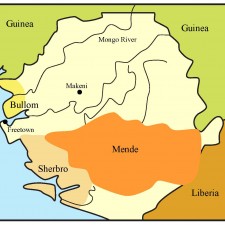
SIERRA LEONE– TEMNE, MENDE AND SHERBRO

The largest pieces in the collection were the Bundu Masks which have a fascination for any collector or enthusiast for West African art. They are an integral part of the woman’s society of the SANDE and it is interesting to realise what a strong role women played in the Mende tribal life.

The MENDE tribe number about 700,000 and are the largest ethnic group in Sierra Leone. They are based in the southern part of the country and are ruled by a hierarchy of chiefs having a paramount chief as head of each district. Their economy is based on rice farming.

BUNDU MASKS OF THE MENDE:

The BUNDU helmet masks are worn by the women of the secret society of the SANDE. The women are of the tribes of the MENDE and TEMNE which are found in Sierra Leone and Western Liberia. The style has been continuous for a century but its origins are unclear. It is thought that the first mask was presented to the SANDE society by the water spirit MAMY WATA but it also could have been made by a sympathetic carver who presented the mask to the leader of the SANDE society to prevent her from being recognised.

The purpose of the SANDE is to accompany the young girls on their passage into the adult community. They will supervise their training in the skills required of them anaesthetize the young girls by hypnosis during female circumcision, and sit and receive the gifts presented to the girls by prospective bridegrooms.

When a woman reaches the middle level of the SANDE society, she commissions a mask which will belong only to her and it will project the personality of a certain spirit. The woman will tell the carver only the name of the mask and he will seclude himself in the bush in order to visualise the personality of the spirit. The mask is cut from a log with a machete. The log is then placed in a hole in the ground and the head cavity is dug out with a long handled chisel and a curved blade. Once this is formed, the log is removed from the hole and the centre of the face is marked. From this line the diamond layout of the face is created from the centre point. Symbolism both physical and spiritual is incorporated. If the hair is created in the three lobed setting, maleness is suggested whereas the arrangement of four lobes signify the female concept. The five lobed hair setting is a phallic symbol. The SHERBRO-MENDE carve a seven lobed setting to present the concept of the complete human unit.

The bulging neck is both symbolic and functional with the MENDE equation of corpulence to fertility. When completed, holes are burned around the base of the neckline to which raffia will be attached and the mask is dyed with juice from the leaves of the kojo vine which takes if first to a bright green but later oxidizes to the desired deep brown. Before the spirit can enter the mask, the costume but be completed to cover the entire body.

Black dyed raffia is attached to the mask, a cloth suit with the end of the sleeves sewn closed is worn over long stockings of often shoes are worn to prevent holes in the stockings through which the spirit would enter the dancer rather than the mask.
Once the woman passes through that stage of the SANDE society and moves upwards, the mask is no longer used but may be offered to the chief as a prestige gift, or transformed to represent the comedian GONDE. In some cases, the retired mask will be decorated with strips of silver or some other metal to denote that they are no longer in use. In order to fully appreciate the BUNDU mask, the dancer should be seen in the dipping and twirling motion which brings the mask to life and as with most of the MENDE art, it invites movement and handling in order to fully appreciate the three dimensional aspects.

The NJAYEI MASK which is different from the BUNDU mask by virtue of the spotted markings and simple lines, is worn by members of the NJAYEI society of which both men and women may be members, but they must first be members of the SANDE (female) or PORO (male) society. The head of the society is a woman who’s house is also the spiritual shrine. The mask is used in the control of sexual behaviour and will be used in ceremonies to aid such problems as mental illness, impotence, fertility, self confidence and personality development. The spotted markings on the mask are symbolic of blood which is closely associated with health and fertility, and white markings which are associated with the spirits.